Introduction
My ancestors all emigrated to Australia in a 35-year period between 1848 and 1883. My goal for my family history work is to confirm my ancestors genetically back to the family that they were born into prior to emigrating.
My great-grandfather Charles Richards had records that could not identify a family in England with him in it. With the advent of DNA testing his history was able to be investigated to find his English family. While investigating my DNA matches for Charles Richards connections, a cluster of matches led to a potential family - James Bomford and his brother Joseph Bomford. James and Joseph Bomford were based in Tarraville, Gippsland between 1856 and 1864 according to Victoria Gazette records and newspaper reports. Emily Macauley, the wife of Charles Richards, was born in Tarraville, Gippsland in 1863 to Mary Ryan and John Macauley as per her birth certificate.
An earlier family historian, Ron Jones, had researched the family of Mary Ryan and documented it as part of the First Families 2001 initiative.1 Much of his work had been validated with newspaper reports, birth, death and marriage certificates where they had been lodged. Additional evidence in Church baptisms was obtained that also validated Ron’s work. The children of Mary Ryan as suggested by Ron have been able to be validated with documents and also genetically which is documented in this report.
This report documents the evidence and conclusion that Emily Macauley is most likely the biological daughter of James Bomford and not John Macauley.
Parentage of Emily McCauley (1863-1906): A DNA-Based Argument of Non-Paternal Event
Research Question
Was Emily McCauley,2 born in Victoria in 1863, the biological daughter of John McCauley, James Bomford, Joseph Bomford or another Bomford male?
Conclusion
Emily McCauley (1863-1906) was the social daughter of John McCauley but was not his biological child. Autosomal DNA evidence demonstrates a non-paternal event in Emily’s parentage. A non-paternal event means that the documented father is not the biological father.
The only ancestral line that consistently explains the observed DNA patterns - including multiple independent matches to descendants of James Bomford (1828-1913) their co-occurrence among Richards’ cousins, and their absence among other descendants of Mary Ryan - is that either James Bomford or his brother Joseph Bomford (1829-1883) or another Bomford male, was Emily’s biological father.
The proposed parentage and cousin-marriage structure of the Bomford family has been tested using BanyanDNA. Emily McCauley was modelled as the daughter of Joseph Bomford, James Bomford, a brother to James, James’ father and James’ uncle as her father. James was 99% likely compared to the other options at 0% each concluding that James Bomford was Emily Macauley’s father.
Although no contemporary documentary record names Bomford as Emily’s father, the combined documentary context, genetic evidence, and exclusion of competing hypotheses strongly support that James Bomford was the biological father of Emily McCauley.
Evidence
-
Birth and Baptism Certificates
Emily Macauley3 was born on 20 August 1863, in Tarraville, Victoria, Australia to Mary Mooney (formerly Ryan) and John McCauley. Her baptism record gives her name as Emilia the daughter of Mary four months after her birth.4 The variation in spelling for Emily compared to Emilia is comparable to some of the variants used for Macauley in this Parish record as shown in Table 1. The baptism record for Emily is also irregular in that the birth date is after the baptism date. The Sale Diocese has confirmed that other baptisms on the record for Emily’s page are dated January 1864 which supports a birth for Emily dated 30 August 1863 rather than 1864 as documented in the Baptism Register:

This places the baptism date of birth of 30 August as comparable to 20 August supplied in the birth certificate.
Emily has three brothers also recorded as the children of Mary Ryan and John McCauley as shown in Table 1 as well as a sister Elizabeth. Elizabeth was not listed on Emily Macauley’s birth certificate and is suspected of dying not long after her baptism. This is also supported by John’s birth only 16 months after Elizabeth’s birth. The Sale Diocese has only Baptism records and is not able to confirm the death of Elizabeth.
Table 1 - Baptism and Birth Data for the Children of Mary Ryan and John McCauley.12 Note that Mary Ryan has no variation in spelling for any of the children’s records.
Birth Baptism Name Father’s Name Victoria BDM / Ward of State 28 May 1858 27 Jun 18585 Henry6 John McAuly 11 May 1858 20 Mar 1860 6 May 18607 Elizabeth John Macauly 3 Jul 1861 1 Sep 18618 John9 John McCawley 3 Jul 1861 30 Aug 186410 31 Jan 186411 Emilia John McCully 20 Aug 1863 William John McCauley 4 May 1865 The baptism records for the children of Mary correlate reasonably with birth records where available and match Ron Jones’ research.1
John and William Macauley, were committed as Wards of the State in 1872 due to neglect. The boys are recorded as illegitimate with William’s date of birth recorded as 4 May 1865 and John born 3 July 1861, both born in Tarraville. The record for the boys said that Mary Ryan had been deserted by John Macauley, who had been imprisoned13 and that she was living with Bill Hamilton on the Nicholson.14
-
Mary Ryan’s Death Certificate and Emily’s Marriage Certificate
Mary Ryan’s death certificate said that she arrived in Australia about 1850 and lived in NSW for two years and then in Victoria where she died in 1895. Her death certificate includes seven children including Emily aged 26 (implied birth year 1869) and does not indicate that any of her children have died. The informant for Mary Ryan’s death certificate was James Taylor the undertaker, and therefore the information is secondary, as it was not known first-hand by the undertaker. The names listed are consistent with other evidence for Mary Ryan’s children, although birth years are generally inconsistent with records, as expected from a secondary informant.
John McCauley is listed as Emily’s father on her marriage record in 1891.15
-
DNA Evidence - Absence of McCauley DNA Signal
Despite autosomal testing, no McCauley-associated autosomal DNA has been identified among assigned matches. Given both the Ryan family and the McCauley families’ Irish origins and the limits of Irish testing coverage, the absence of McCauley matches is not conclusive negative evidence. The absence is consistent with John McCauley not being the biological father, but cannot independently establish it.
-
DNA Evidence16
A well-defined autosomal DNA cluster confirms descent from Mary Ryan as shown in Appendix 2. Another cluster was identified that appeared to be associated with James Bomford (1828) as most of the matches were descendants of him. The Bomford family tree is well documented and provided clarity as to the family tree for James Bomford.17
The documentary chains for the testers are reasonably robust. All testers have been able to be placed in the tree based on trees in their profile and documents to validate where possible given Australian privacy laws. Where a parent is still alive and marked as private this information is considered to be true. In some cases, the testers have been communicated with and provided confirmation.
BanyanDNA18 was used to assess whether the DNA evidence suggests and supports a relationship that a Bomford male fathered Emily McCauley, born in Victoria in 1863.
BanyanDNA generates expected mean cM, expected cM ranges (mean plus one standard deviation) based on the specific tree structure entered by the researcher, rather than relying on predetermined relationship ranges. This methodology is based on likelihood models for forensic genealogy developed by Press and Hawkins.19 The testers shared DNA in cM is compared to the calculated mean cM and the number of standard deviations between the two values is calculated by BanyanDNA.
To assess this hypothesis two questions were investigated:
- Was Emily Macauley the full or half sister of Henry Macauley?
- Was Emily Macauley the daughter of a Bomford male?
To investigate the questions, the trees descending from Emily Macauley, Thomas Mooney and James Bomford first needed to be validated. The trees are shown in Appendix 3.
To validate the trees the standard deviations between the test cM and the calculated cM is assessed. BanyanDNA’s published guidance20 interprets standard deviation values as follows:
- Less than 1.0 standard deviations indicates that the relationship is probably correct;
- 1.0-2.0 standard deviations should be reviewed although up to 30% of matches in this range is normal;
- Above 2.0 standard deviations requires a careful review;
- Above 3 standard deviations suggests the match is likely related differently than proposed in the tree.
The tree structure, match data, simulation results - mean cM, expected cM range, and standard deviation calculations are stored in a JSON file held by the researcher.21 The number of testers, number of matches and standard deviations that are greater than 1.0 for each branch and between the descendants of the branches are included in Table 2.
Table 2. Validation of DNA Matches, 10K iterations.
Family Head # Testers # Matches Std Deviations 1.0-2.0 Validated Emily Macauley 8 28 4 - 1.2, 1.2, 1.1, 1.1 Validated 14% < 30% Henry Macauley 2 1 Not calculated Not assessable Thomas Mooney 3 3 None Not enough data 0% < 30% Mary Ryan 13 23 3 - 1.3, 1.5, 1.5 Validated 13% < 30% James Bomford 10 40 11 - 1.1, 1.1, 1.1, 1.3, 1.4, 1.4, 1.4, 1.7, 1.9, 1.9 Validated 25% < 30% Hemming Bomford 1739 11 10 2 - 1.1, 1.1 Validated 20% < 30% All trees and branches validated with less than 30% standard deviations between 1.0 and 2.0 standard deviations, except for the Henry Macauley and Thomas Mooney branches due to small numbers of testers able to be placed in the tree. The Henry Macauley branch fits into the wider Mary Ryan tree with standard deviations at 1.5, 1.0, 0.8, 0.7, 0.6, 0.2, 0.2, 0.1, 0.0, one of nine matches >1.0. The Thomas Mooney branch fits into the wider Mary Ryan tree with standard deviations at 1.5, 1.5, 1.3, 1.0, 1.0, 0.7, 0.6, 0.5, 0.4, 0.4, 0.4, 0.3, 0.2, 0.2, 0.1, 0.1, three of sixteen matches >1.0.
Note that no Bomford matches match to descendants of Mary Ryan’s children except the descendants of Emily Macauley. Bomford matches cannot be explained via Charles Richards as his ancestry is known.
The connection between Emily Macauley’s tree and Henry Macauley’s tree was assessed to determine whether with the limited data a half or full relationship between Emily and Henry could be determined. A validation was run in BanyanDNA for each option and the validation data imported into Stephen Voels Bayes Relative Probabilities - Validation tool.
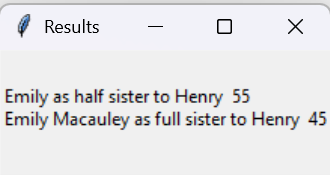
The result is ambiguous which is not surprising as the number of testers is insufficient to differentiate between full and half siblings. Stephen Voels has shown that for a common great-great-grandparent (i.e. Mary Ryan) that 28 match pairs from 11 testers are needed for a 95% confidence.22 An additional two to three testers descending from Henry Macauley would be needed to validate the relationship as well as more than the current nine match pairs.
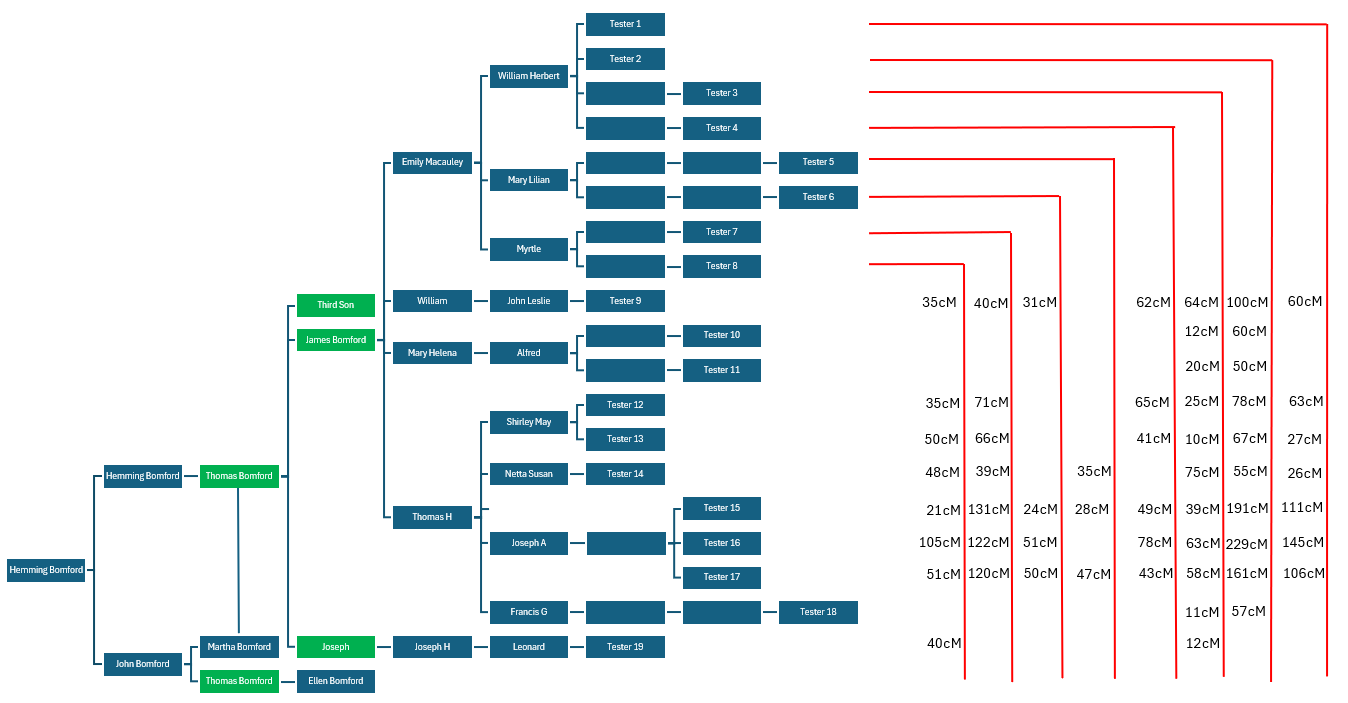
The connection between Emily Macauley’s tree and the Bomford tree were assessed with five hypothetical Bomford males as the father of Emily. These males are highlighted in green in Appendix 3A and are: James Bomford, his brother Joseph, his father Thomas born 1802, his uncle Thomas born 1799, and a hypothetical third brother to James. The hypotheses were assessed using the Validation process in BanyanDNA and then assessed using Stephen Voels Bayes Relative Probabilities - Validation tool.
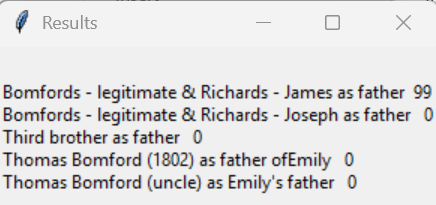
The results are conclusive with James Bomford being the preferred hypothesis of the five hypotheses tested at 99%.
A further question was also assessed: was Emily the full or half sister of James Bomford’s legitimate children? The connection between Emily Macauley’s tree and James Bomford’s tree was assessed with and without Mary Ryan connected to determine whether a half or full relationship between Emily and James’s Bomford’s children could be determined. A validation was run in BanyanDNA for each option and the validation data imported into Stephen Voels Bayes Relative Probabilities - Validation tool.
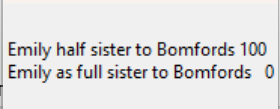
The results are conclusive Emily showing as a half-sister to the Bomford siblings at 100%. For 95% confidence, 28 match pairs are required with five descendants on one tree and six descendants on the other tree. There are eight testers on Emily Macauley’s tree and ten testers on James Bomford’s tree with 56 matches between them as shown in Appendix 3A, exceeding the 95% confidence for this result.
-
Timing and Opportunity
James and Joseph Bomford arrived in Melbourne prior to January 1855. Their brother Hemming placed an advertisement looking for his brothers James and Joseph in The Argus in January 1855.23 Hemming must have found his brothers, as when he died in 1856 from TB, he had Joseph listed as next of kin and living in Tarraville.24 James’ residence in Tarraville is proven by a letter detained for him and advertised in February 1859 living at Tarraville25 as well as another letter sent to the three brothers Jos. J. and H. Bomford in 1856.26 At some stage James and Joseph went into partnership as J. & J. Bomford in Tarraville to sell “drapery, ready made clothing, boot and shoes” as in July 1864 they were advertising that the partnership was being dissolved.27 The brothers renewed their partnership in Stratford and James exited the Tarraville area in 1866.28 By 1869 James was a grocer in Stratford and had married Susan Napper in Sale.29
Emily was conceived in late 1862 based on her date of birth.4 Mary Ryan resided in Tarraville from at least 1854 when her daughter Rosanna Mooney was born until William’s birth in 1865 as per Table 1.
This establishes chronological and geographical plausibility.
Evidence Evaluation / Evaluation of Competing Hypotheses
Hypothesis 1: John McCauley was Emily’s biological father
Rejected as unlikelySearches among assigned paternal matches identified no McCauley-associated autosomal DNA clusters or ThruLines or trees with a McCauley (or variant) named person. Given John McCauley’s Irish origin, his collateral relatives face the same testing coverage limitations as other Irish families in this dataset, and the absence of identified McCauley matches is not conclusive negative evidence against his biological paternity. The primary basis for excluding John McCauley as Emily’s biological father is the positive Bomford DNA evidence documented in Section 4.
Hypothesis 2: James Bomford was Emily’s biological father
Conclusion: Supported Basis of Support:- The Bomford connection was established using Ancestry’s Cluster tool (Appendix A2). The decisive feature of the Bomford evidence is not the existence of isolated matches, but the consistent recurrence of Bomford descendants among Emily Macauley’s descendants, combined with their systematic absence among other descendants of Mary Ryan. This pattern is only explainable if Bomford ancestry enters the pedigree through Emily herself.
- Internet research found that the Bomford family tree is well researched.17 It shows that James and Joseph Bomford were the sons of Thomas Bomford and Martha Bomford who were first cousins. The proposed parentage and cousin-marriage structure of the Bomford family was tested using BanyanDNA30 (Appendix 3A).
- James Bomford’s presence in Tarraville, Victoria from 1859 to 1866, combined with Mary Ryan’s established residence in Tarraville, establishes chronological and geographical opportunity consistent with Emily’s conception in late 1862.
- No alternative paternal hypothesis accounts for the observed DNA structure without introducing additional unsupported non-paternal events.
- While chromosome-level triangulation is unavailable due to the use of AncestryDNA, the combination of multiple independent Bomford DNA matches, autosomal cM values across descendant lines consistent with their positions in the family tree as assessed by BanyanDNA, absence of Bomford DNA in non-Emily descendants of Mary Ryan, and Bayesian Relative Probability analysis supports James Bomford as Emily’s biological father and renders chromosome triangulation unnecessary to resolve the research question.
- No contemporary documentary record explicitly names James Bomford as Emily’s father; the conclusion rests on indirect documentary evidence and autosomal DNA analysis.
Hypothesis 3: Joseph Bomford was Emily’s biological father
Rejected as unlikelyBanyanDNA and Bayesian Relative Probability analysis validation of the model of that Emily McCauley as the daughter of Joseph Bomford, produced a 0% likelihood of this model compared to 99% for James being Emily’s father.
Hypothesis 4: Thomas Bomford 1802, father of James Bomford, was Emily’s biological father
Rejected as unlikelyBanyanDNA and Bayesian Relative Probability analysis validation of the model of Emily McCauley as the daughter of Thomas Bomford (1802), produced a 0% likelihood of this model compared to 99% for James being Emily’s father.
Hypothesis 5: Third Bomford brother of James Bomford was Emily’s biological father
Rejected as unlikelyBanyanDNA and Bayesian Relative Probability analysis validation of the model of Emily McCauley as the daughter of another brother of James Bomford, produced a 0% likelihood of this model compared to 99% for James being Emily’s father.
Hypothesis 6: Thomas Bomford (1799) uncle of James Bomford was Emily’s biological father
Rejected as unlikelyBanyanDNA and Bayesian Relative Probability analysis validation of the model of Emily McCauley as the daughter of another brother of James Bomford, produced a 0% likelihood of this model compared to 99% for James being Emily’s father.
Closing Statement
The evidence supports the conclusion that Emily McCauley was not the biological daughter of John McCauley, despite being documented as such. Autosomal DNA evidence, corroborated by documentary evidence of opportunity, establishes a non-paternal event and identifies James Bomford as the most likely Bomford male to be Emily’s biological father.
Acknowledgement
The research in this report was conducted from September 2025- April 2026.
AI tools assisted with the researcher learning how to do genealogy as well as initial drafting of this report to provide a format and collation of initial research.
Claude using Steve Little’s Genealogical Research Assistant v8.5.1c, “A research assistant designed to follow GPS methodology, for genealogists at every level”, was used to critique and help the author improve their GPS arguments.
AI tools were also used to check citations against the Elizabeth Shown Mills Evidence Explained citation standard.31 All citations were reviewed and updated by the researcher.
All sources have been personally found and verified by the researcher. No research or sources were supplied by AI tools.
Ron Jones published research conducted as part of the 2001 First Families initiative1 which is archived on Trove and referred to throughout this research.
BanyanDNA and John Motzi have been very supportive by providing information as to how the software analyses tree and match data.
Appendix: DNA Evidence Supporting the Parentage Analysis of Emily McCauley
A1. Testers and Scope
Test taker: Sharon Richards
Platform: AncestryDNA
Total matches: >7,600 paternal matches
No chromosome-level data available
A2. Methodology Summary
Cluster analysis using Ancestry’s clustering tools.
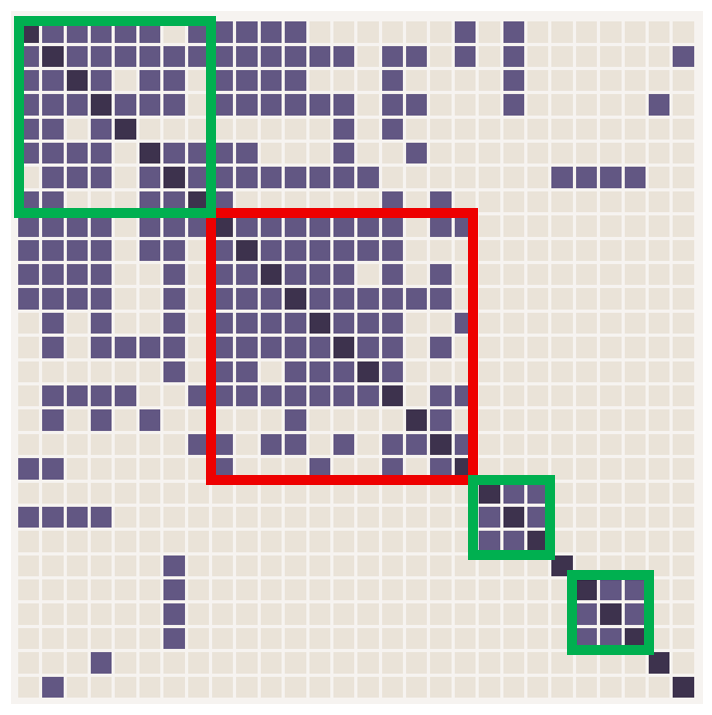
Ancestry Standard Cluster - paternal matches - are shown below. The blue cluster highlighted in the red box are the tester’s paternal grandmother’s line (Linford) matches. The pink cluster is the tester’s paternal grandfather’s line (Richards) matches. The matches in the blue box were unable to be identified as paternal cousins. The tester has a paternal great-grandfather of unknown ancestry.
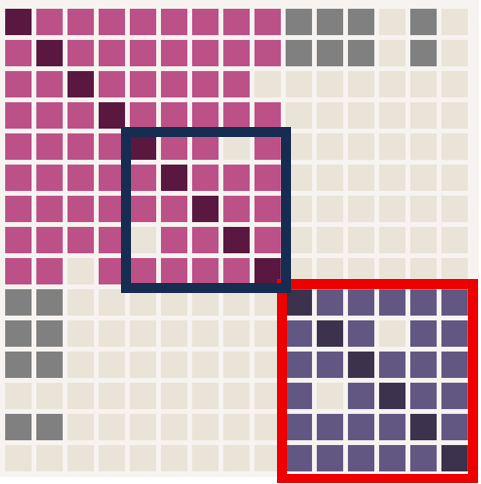
To investigate the unknown matches a custom cluster was created. The custom cluster was built based on a cousin (Tester 6) who is a descendant of Charles Richards and Emily McCauley in order to eliminate the Linford matches. Additional shared matches of other second cousins (Tester 7 and Tester 8) were used as sidekicks. A cM range of 20-100cM for the matches to the researcher was selected to include matches that were higher but unexplainable.
Exclusion of matches attributable to:
- the descendants of Charles Richards and Emily Macauley are in the top 8 rows - large green square
- the bottom small cluster of 3 people was investigated and found to have Luke Cobb (born 1735) as a most recent common ancestor. This family remained in England. This family has since been shown to be ancestors of Emily’s husband, Charles Richards.
- The second from bottom cluster was found to be the descendants of Mary Ryan and Thomas Mooney.
- The large cluster, outlined in red was found to descend from the Bomford family.
A3. BanyanDNA Modelling
Appendix 3A: The Bomford family tree structure.
Red lines show DNA connections between descendants of Emily Macauley and the descendants of her biological father James Bomford and his wife, Susan Napper. cM values show the size of shared DNA between connected individuals where visible to the researcher. Matches of matches below 20cM are not visible on AncestryDNA to the Researcher.
The people highlighted in green were all tested as hypothetical fathers for Emily Macauley.
“Private” denotes an individual whose identity is withheld for privacy reasons. All testers’ names have been replaced with anonymised Tester #.
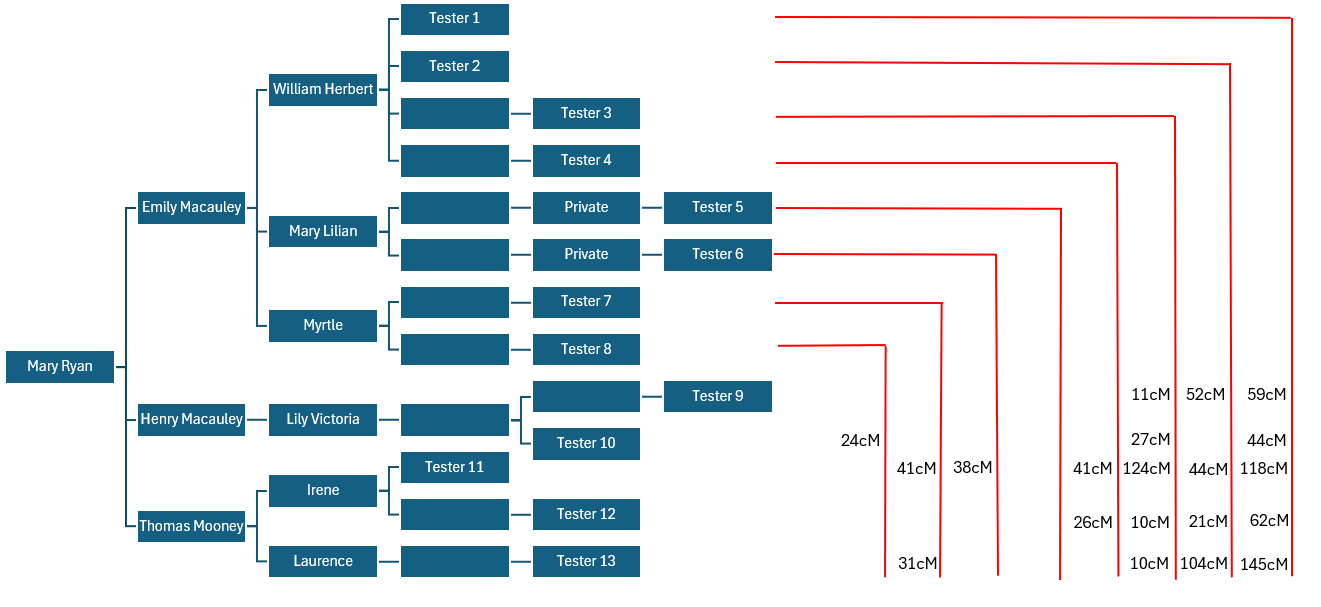
Appendix 3B: The Mary Ryan family tree structure.
Red lines show DNA connections between descendants of Emily Macauley and descendants of her half-brothers Thomas Mooney and Henry Macauley. cM values show the size of shared DNA between connected individuals where visible to the researcher. Matches of matches below 20cM are not visible on AncestryDNA to the Researcher.
Emily Macauley was tested as both a full sister and half sister to Henry Macauley.
“Private” denotes an individual whose identity is withheld for privacy reasons. All testers’ names have been replaced with anonymised Tester #.
Endnotes
- National Library of Australia, First Families 2001 [electronic resource], https://catalogue.nla.gov.au/catalog/3422591 : accessed 12 Apr 2026.
- Emily’s surname appears as McCauley in her birth registration and in her siblings’ birth records, and as Macauley in her marriage record and in her children’s birth registrations where she was the informant. Both spellings are used in this document consistent with the source being referenced.
- Births, Deaths and Marriages Victoria, Register of Births, District of Alberton, no 18241 (1863), Emily McCauley; born 20 August 1863, Tarraville; digital image, Births, Deaths and Marriages Victoria, www.bdm.vic.gov.au : purchased 2025 by Sharon Richards, Australia.
- Baptismal Register for Gipps Land (Nov 1851), known locally as the Tarraville register, Catholic Diocese of Sale, 6 Witton St, Warragul, Victoria, Australia; entry for Emilia McCully, baptised 31 January 1864, born 30 August 1864, daughter of John McCully and Mary Ryan; digital image supplied by archivist, 14 Apr 2026.
- Baptismal Register for Gipps Land (Nov 1851), known locally as the Tarraville register, Catholic Diocese of Sale, 6 Witton St, Warragul, Victoria, Australia; entry for Henry McAuly, baptised 27 June 1858, born 28 May 1858, son of John McAuly and Mary Ryan; digital image supplied by archivist, 14 Apr 2026.
- Births, Deaths and Marriages Victoria, Register of Births, District of Alberton, no 14754 (1858), Henry McCauley; born 11 May 1858, Tarraville; digital image, Births, Deaths and Marriages Victoria, www.bdm.vic.gov.au : purchased 2025 by Sharon Richards, Australia.
- Baptismal Register for Gipps Land (Nov 1851), known locally as the Tarraville register, Catholic Diocese of Sale, 6 Witton St, Warragul, Victoria, Australia; entry for Elizabeth Macauly, baptised 6 May 1860, born 20 March 1860, daughter of John Macauly and Mary Ryan; digital image supplied by archivist, 14 Apr 2026.
- Baptismal Register for Gipps Land (Nov 1851), known locally as the Tarraville register, Catholic Diocese of Sale, 6 Witton St, Warragul, Victoria, Australia; entry for John McCully, baptised 1 September 1861, born 3 July 1861, son of John McAuly and Mary Ryan; digital image supplied by archivist, 14 Apr 2026.
- Public Record Office Victoria (PROV), Ward Register (Children’s Registers, 1864-1887), VPRS 4527/P0000, Book 8 (Boys Neglected, entries 5867-8913), p. 68, entries for William Macauley and John Macauley, 20 January 1872-25 November 1878; digital image, Public Record Office Victoria (prov.vic.gov.au : accessed 10 March 2026).
- The date in the record is 30 Aug 1864 but this has been found to be recorded incorrectly by the archivist at the Sale Catholic Diocese as the other entries.
- Baptismal Register for Gipps Land (Nov 1851), known locally as the Tarraville register, Catholic Diocese of Sale, 6 Witton St, Warragul, Victoria, Australia; entry for Emilia McAuly, baptised 31 January 1864, born 30 August 1864, daughter of John McAuly and Mary Ryan; digital image supplied by archivist, 14 Apr 2026.
- Baptismal Register for Gipps Land (Nov 1851), known locally as the Tarraville register, Catholic Diocese of Sale, 6 Witton St, Warragul, Victoria, Australia; entries as per Table 1; digital image supplied by archivist, 14 Apr 2026.
- Public Records Office of Victoria (PROV), VPRS 515/P0000, Volume 24 (entries 13792-14256, 1876), Central Register for Male Prisoners, p. 323, entry for John Macauley, no. 14105; digital image, Public Record Office Victoria, image 334 (https://prov.vic.gov.au/archive/1C7E69FB-F3A9-11E9-AE98-A5039B372CB1?image=334 : accessed 10 March 2026).
- Public Records Office of Victoria (PROV), VPRS 4527/P0000, 5867-8913, Boys neglected. Book 8, 20 Jan 1872-25 Nov 1878, 6124- William Macauley and 6125- John Macauley; digital image, Public Record Office Victoria, image 68 of 736, (https://prov.vic.gov.au/archive/A0C05808-F4C7-11E9-AE98-17B2886C03DB?image=68 : 31 Mar 2026).
- Births, Deaths and Marriages Victoria, Register of Marriages, District not listed, no 5451 (1891), Emily McCauley and Charles Richards; married 30 July 1891, West Melbourne; digital image, Births, Deaths and Marriages Victoria, www.bdm.vic.gov.au : purchased 2025 by Sharon Richards, Australia.
- AncestryDNA match list for Sharon Richards, Ancestry (ancestry.com : accessed 11 March 2026).
- “The Bomfords of Worcestershire, Annotated Family Tree,” bomford.net; compiled by Bomford family researchers, earliest generation born 1873 (bomford.net/worcestershire/tree2annotated.htm : accessed 11 March 2026).
- BanyanDNA: Margaret Press, Leah Larkin, Jaren Campbell, Carson Wilde, Mike Charleston, (https://www.banyandna.com : 21 Mar 2026).
- Press, William H. and John Hawkins, “Likelihood Models for Forensic Genealogy,” arXiv preprint arXiv:2010.02985 (2020), (accessed 21 Mar 2026). This preprint paper has not been peer reviewed.
- BanyanDNA, “Calculations”, BanyanDNA Documentation (https://www.banyandna.com/docs/calculations : accessed 1 Apr 2026).
- BanyanDNA JSON file for project “Mary Ryan Descendants”, Mary Ryan Descendants.json, generated 10 Apr 2026, held by Sharon Richards. Contains tree structure, match data, mean cM, expected cM ranges, standard deviation variances and chi-square values. BanyanDNA, “Mary Ryan Descendants”, (https://app.banyandna.com/project/fcd3fcfa-8265-41d9-b1fd-7bc00e6f7568 : 10 Apr 2026), probabilities for tree placement for descendants of Mary Ryan (MRCA: Mary Ryan with partners Thomas Mooney, John Macualey and James Bomford).
- Stephen Voels, post in BanyanDNA Facebook Group, 25 January 2026, Facebook (https://www.facebook.com/groups/banyandnausergroup/permalink/1547963436429040/ : accessed 25 Mar 2026). Create a table of Stephen Voels calculations, summarized by Claude, version 4.6 Sonnet, modified by Yvonne Fenster, chat initiated by Yvonne Fenster on 25 March 2026, Anthropic (https://claude.ai : accessed 25 Mar 2026).
- “New Advertisements”, The Argus (Melbourne), 11 Jan 1855, p. 1; digital image, Trove (https://trove.nla.gov.au/ : accessed 11 March 2026), article no. 4802962.
- Births, Deaths and Marriages Victoria, Register of Deaths, District of St. Kilda, no 4962 (1856), Hemming Bomford; died 7 October 1856, St Kilda; digital image, Births, Deaths and Marriages Victoria, www.bdm.vic.gov.au : purchased 2025 by Sharon Richards, Australia.
- “Uncollected Letters”, Victoria Government Gazettes, 1851-1907, 4 February 1859, p. 336, entry for James Bomford, Tarraville; digital image, Ancestry (ancestry.com : accessed 11 March 2026).
- List of Unclaimed Ship Letters for the week ending 8th December 1856, General Post Office Melbourne, Victoria Government Gazettes, 1851-1907, 8 December 1856, p. 2120, entry for Bomford, Jos. J. and H. Bomford; digital image 2125 of 2269, Ancestry (ancestry.com : accessed 21 April 2026).
- “Notice”, Gippsland Guardian (Victoria), 29 Jul 1864, p. 3; digital image, Trove (https://trove.nla.gov.au/ : accessed 11 March 2026), article no. 109907940.
- “Trade Addresses”, Gippsland Times (Victoria), 12 Jul 1866, p. 4; digital image, Trove (https://trove.nla.gov.au/ : accessed 11 March 2026), article no. 61204869 and “Melbourne Criminal Sessions”, The Age (Melbourne), 20 Aug 1866, p. 6; digital image, Trove (https://trove.nla.gov.au/ : accessed 11 March 2026), article no. 160218771.
- Births, Deaths and Marriages Victoria, Register of Marriages, District of Sale, no 1401 (1869), James Bomford and Susan Napper; married 6 May 1869, Sale; digital image, Births, Deaths and Marriages Victoria, www.bdm.vic.gov.au : purchased 2025 by Sharon Richards, Australia.
- Parentage analysis conducted using BanyanDNA (banyandna.com : accessed 27 February 2026); BDNA JSON output generated using tool described in Nancy Lecompte, comp., An Unofficial Reference Guide to BanyanDNA, BanyanDNA.com (April 2025), featured document, “BanyanDNA User Group,” Facebook (facebook.com : accessed February 2026), PDF on file with Sharon Richards, Australia. Parentage Analysis Results on file, Project: “Bomford & Richards - which brother (no child matches)”, with Sharon Richards, Australia. Support provided by BanyanDNA Community.
- Elizabeth Shown Mills, Stripped Bare Guide: Citing and Using History Sources (Kindle edition, 2026) and Elizabeth Shown Mills, Evidence Explained, (evidenceexplained.com : 11 March 2026), Forums.