The letters collected on the Fanny & Hermann page end on the French Riviera - a glorious sunset at Menton, the failed attempt to break the bank at Monte Carlo, and the long road back to Genoa. The last of them was written at Mentone in December 1907, but it did not reach print until July 1908 - by which time the Riecks were already home. Hermann was at Coffs Harbour by 31 May 1908, the day he signed the agreement below. They were home for five years.
In 1913 they left again, this time for Hermann’s health. He was in his mid-seventies. They said farewell to Fanny’s family in South Australia, visited old friends in Adelaide, and sailed back to the country they had loved for nearly a decade. They found a cottage in Deisenhofen, a village south of Munich, close to the Alps. They intended to spend the winters in Italy.
The war found them there in August 1914.
What followed - detention, hunger, the blockade, revolution, two fires, and Hermann’s death - Fanny eventually told in her own words. The documents gathered here trace that arc: from the last cheerful letters of 1913, through the private letters that still found their way to old friends in Australia during the war and its aftermath, to Fanny’s own accounts of what those years had been.
Almost nothing of these years reached the newspapers. But the Riecks kept writing to old friends in the Coffs Harbour district, and several of those private letters survived. Two of them - written to the Campbell family of Korora in 1919 and 1920 - are held today by the Yarrila Arts & Museum in Coffs Harbour, together with the document that would cost Fanny her British nationality. They are gathered below, beside the one letter a newspaper did publish.
From the years the Riecks spent back at Coffs Harbour, one document survives - and it is the earliest firm evidence that they were home. Hermann wrote it out in his own hand: a share-farming agreement with Fanny’s brother Thomas, settling an earlier arrangement the two men had struck thirteen days before the Riecks sailed for Europe in 1898. It names the land, the tools, the horses, and every one of the nine head of cattle.
-
31 May 1908The share-farming partnership at Pine Range - Spanker, Redman, Bally and the rest - the freehold portions at Moonee - and Fanny, written into the agreement as one person with her husband
-
Feb. 1913Hermann writes from Adelaide as he farewells Australia to return to Europe for his health - the 1866 Danube journey - the Balkan Wars - and the coming storm
-
Mar. 1913Hermann writes from Fanny’s home town - old friends in Adelaide - Meyer the tinsmith - Port Pirie & the smelting works - a last look at Australia
-
Dec. 1913Fanny writes from Weilheim - 9,000 soldiers pass through - field kitchens - aeroplanes descending like enormous birds - the Wangen Apostles
-
Dec. 1913The centenary of the Battle of Leipzig - Barnum’s lions loose in the streets - the English guest and the knock at his door - eight months before the war
1915-1921
These were the years of detention and deepening hunger, the revolution that reached their village, the two fires, and Hermann’s death in August 1921. Little of it could be sent home as it happened - yet a few private letters did reach old friends in Australia, and survive. Fanny set the rest down later, once she was safely back.
Weeks after the Armistice, on 27 January 1919, Hermann was naturalised as a German in the new republican Bavaria - and under the law of the day Fanny, as his wife, became German with him. It is the reason she would one day return to Australia a foreigner. The certificate survives, and so do two of the private letters the Riecks sent to the Campbell family of Korora - proof that, even in these years, word still reached home.
-
27 Jan. 1919Hermann and Fanny naturalised as Germans at Munich - the document that changed Fanny’s nationality - with full transcription and English translation
-
7 Sept. 1919Fanny writes from Deisenhofen as the post reopens - rationing and prices - substitutes for sugar, tea, coffee and cloth - news of home - and homesickness for Coffs Harbour
-
11 Oct. 1920Hermann, in his 84th year, writes of his old Korora farm - living through the war as “English prisoners” - buying land to avoid internment - and the cancelling of the life-lease on his former home
-
Sept. 1922Fanny’s first account after returning to Australia - the return to Europe - the war years in Bavaria - hunger - the revolution - the fires - and Hermann’s death
-
Oct. 1923Fanny’s full account written with time to reflect - detention - starvation rations - the Bavarian revolution - the fire of 3 March 1921 - Hermann’s death at Deisenhofen
-
Nov. 1923Fanny leaves Munich alone - farewell to the Rhine - the passport crisis at Aachen at 3 a.m. - white bread on the Channel ferry - eight days in London - the long voyage round the Cape - and Sydney at last
Before leaving Australia in 1913, Hermann had purchased a life assurance annuity from an American company, intended to provide Fanny with about £3 a week for life. Hermann had naturalised as an Australian - a British subject - in June 1886, and through the war he and Fanny were treated in Germany as enemy British subjects. On 27 January 1919, however, weeks after the Armistice, Hermann was naturalised as a German in the new republican Bavaria, and under the law of the day his wife took his nationality with him - so Fanny, too, became German (see the naturalisation certificate). That is why, on her return, the Australian authorities treated her as a German national: she could not recover the annuity Hermann had arranged until she was renaturalised as an Australian, a process still incomplete in December 1922. The financial figures in this notice are consistent with Fanny’s own account of her departure from Munich, published in The Queenslander, 17 November 1923 (Trove ↗).
Hermann Rieck sailed in 1913 and did not come back. Thomas Cox, his partner in the 1908 agreement, was dead by 1915. What survived him in the Coffs Harbour district were smaller things: an iron, a mark, and a name.
In August 1894 he had registered a cattle brand - the letter R followed by a reversed C - under the Registration of Brands Act of 1866. It is the brand carried by the nine head named in the 1908 agreement. The clerk who entered it in the Government Gazette spelled the surname “Reick.” The branding iron itself is held today by the Yarrila Arts & Museum.
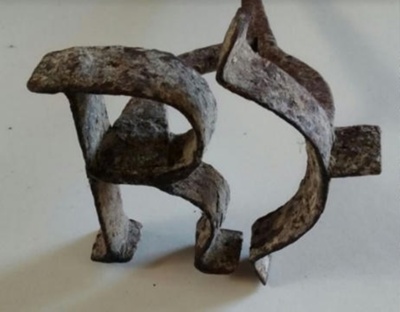
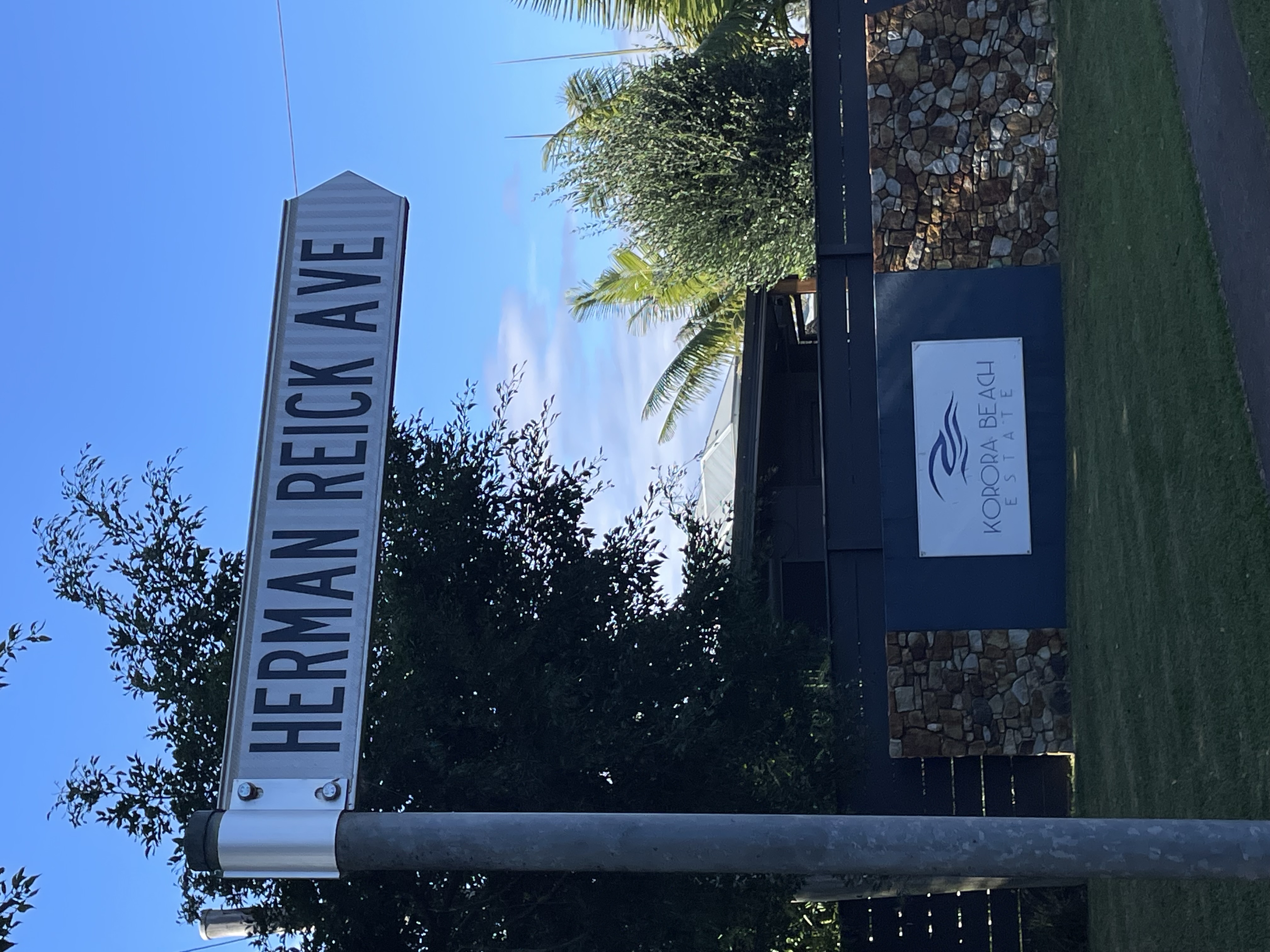
The road stands at Korora, where Hermann Rieck farmed. The spelling on the sign is the one the Gazette clerk used in 1894. It outlasted him too.
The 1913 letters appeared in the Clarence and Richmond Examiner (Grafton, NSW), the same paper that published the earlier travel series. The 1914 and 1920 items are excerpts from private letters quoted by newspapers; they appear here on this page rather than as separate letter pages, as their brevity and private nature make a full citation treatment inappropriate. The 1922 article appeared in the Daily Examiner (the successor paper to the Clarence and Richmond Examiner); the 1923 articles appeared in the Women’s Department of The Queenslander (Brisbane). All newspaper sources are available through Trove, National Library of Australia. The 1919 naturalisation certificate and the two private letters of 1919 and 1920 are held by the Yarrila Arts & Museum, Coffs Harbour, and are reproduced here by courtesy of the City of Coffs Harbour; each has its own transcription page. Transcriptions follow the project’s methodology, with uncertain readings flagged in transcriber’s notes on each page.