A Sussex Boy Goes to Sea
The Cobb and Voller families had lived in and around Linchmere, in the western High Weald of Sussex, for generations. DNA analysis has traced both lines back to the early-to-mid eighteenth century - five or six generations rooted in the same small corner of woodland Sussex.1 The men were predominantly agricultural labourers, their lives shaped by the Wealden countryside and in particular by its woodland trades. In the 1851 census, Richard's grandfather, also named Richard Cobb, appears at the age of seventy-one as a "labourer in woods," with his son Thomas - Richard's father - recorded beside him, suggesting Thomas was already working in the same tradition. This was the world of coppicing, charcoal burning, bark stripping for the tanneries, and timber work that had sustained Wealden families for centuries. But by the time Richard and his younger brother Herbert were growing up in the 1860s and 1870s, that world was contracting. Industrialisation had steadily undercut the woodland trades - coal displaced charcoal, factory-made goods replaced hand-crafted woodland products, synthetic tanning agents eroded the market for oak bark.2 The sons of woodland labourers in Linchmere were inheriting a way of life that was running out of future.
Both brothers found their answer on the water. Richard signed his indentures as a Merchant Navy apprentice at Littlehampton in December 1877,3 at sixteen; Herbert enlisted in the Royal Navy five years later, in September 1882,4 at nineteen. That two boys from the same Sussex household made for the sea within five years of each other is perhaps less surprising than it might seem - the merchant trade and the Royal Navy both offered something the woods of Linchmere no longer could: a skilled occupation, a wage, and a future.
On 17 April 1861, Richard Cobb was born in Linchmere.5 He was the son of Thomas Cobb (1817-1898), a labourer, and his wife Harriett, née Voller (1826-1872), and he grew up in a household that would eventually include siblings William, Louisa, Herbert, Harriett, and Leticia. The family appeared together in the 1871 census, with Richard recorded alongside his parents and brothers and sisters at Linchmere.6 Richard's mother, Harriett, died in 1872 when Richard was about eleven, and his youngest sister Leticia followed her to the grave in December 1873. For a boy growing up in a labourer's household, already touched by grief, the sea must have offered something the village could not - possibility and escape. Thomas Cobb outlived his vanished sons' departures by more than two decades, ending his days in Rustington - a coastal village two miles from Littlehampton, where Richard signed his papers and sailed away. He was buried at St Peter and St Paul Church on 23 November 1898, aged eighty-one, with his son William present at his death. Of Thomas's three sons, William was the one who stayed in England.7
On 11 December 1877, Richard was formally bound as an apprentice in the Merchant Navy at Littlehampton, Sussex, to serve a three-year term aboard a three-masted sailing ship called the Falcon, under Master Richard J. Burt. The Falcon (official register no. 43512) was a vessel of 303 tons net, built in 1864 and owned by G. & J. Robinson of Littlehampton. Within days of his indenture, on 17 December 1877, she set sail for St Lucia via Cardiff.8
Over the next three and a half years, Richard saw more of the world than most men twice his age. All of it was aboard sailing vessels - small ones, working the commercial trade routes in all weathers. Aboard the Falcon, he visited the Caribbean islands of St Lucia and Jamaica, crossed to Bermuda, called at Wilmington in North Carolina, sailed as far south as the Falkland Islands, touched at Hamburg and the River Tyne, and rounded through the English Channel more times than could easily be counted. These were not pleasure voyages - the South Atlantic in winter, the Southern Ocean, the waters off Cape Hatteras where the Gulf Stream and the Labrador Current collide over shifting sandbars in a stretch of coast known as the Graveyard of the Atlantic9 - and the ships were small enough that every sea state was felt. By the time he appeared in the 1881 census - recorded aboard the Falcon on 3 April 1881, listed as an able-bodied seaman, unmarried, born in Littlehampton, Sussex - he was a seasoned young sailor of nineteen.10
Southward Bound: From Europe to Australia
Richard was discharged from the Falcon by mutual consent at Honfleur, France on 12 April 1881, and immediately signed on to the Bridesmaid (official no. 71482, registered at Swansea), joining several of his former crewmates in the move.11
By late May 1881, Richard had joined the Kentish Tar, a sailing ship bound from London to Cardiff and then to Cape Town, arriving at Table Bay on 24 August 1881.12 It was probably at Cape Town that Richard's path crossed with that of the Morning Star, a three-masted schooner of 258 tons captained by James Innes, working the route between southern Africa, Mauritius, and the Australian colonies.13 By April 1882 the Morning Star had sailed from Mauritius for Melbourne. On 10 May 1882, crossing the Southern Ocean at latitude 39° south, she was struck by a severe gale that swept everything movable from the deck.14 She limped into Melbourne on 25 May 1882.
Richard made a return voyage to Mauritius and back to Melbourne.15 But when the Morning Star arrived in Melbourne again on 15 December 1882,16 something had changed. On 18 January 1883, Richard Cobb was recorded in the official Victorian deserters' register as having absconded from the Morning Star, his previous vessel listed as the Kentish Tar, his birthplace given as Sussex.17 He was twenty-one years old, newly arrived in a young colonial city, and - it seems - determined to start again.
A New Name, A New Life: Charles Richards in Melbourne
Sometime after his desertion, Richard Cobb reinvented himself as Charles Richards. Whether the motive was the shame of desertion, a wish to sever ties with a difficult past, or simply the intoxicating sense of possibility that colonial Melbourne offered a young man with strong hands and no ties, the name change served him well. The eight years between his desertion in early 1883 and his marriage in 1891 remain largely undocumented. Systematic searches of Trove, Ancestry, and the Public Record Office of Victoria for both Richard Cobb and Charles Richards across this period have produced no relevant results - a silence that speaks either to the effectiveness of his new identity or to the ordinary invisibility of a working man making his way without leaving many traces. The marriage certificate describes him as a labourer, which tells us his occupation at that moment but nothing about where he had been or what he had done in the intervening years.
On 30 July 1891, Charles Richards married Emily Macauley at St Mary's Roman Catholic Church, West Melbourne. Emily had been born in 1863 at Tarraville, in Victoria's Gippsland, and raised as the daughter of John and Mary Macauley; recent DNA analysis has since revealed that her biological father was James Bomford (1828-1913), a prosperous storekeeper in Stratford, Gippsland. Emily almost certainly did not know of this connection during her lifetime, and neither did Charles. On the marriage certificate, Charles described himself as a labourer, born in England in about 1865, and gave his parents' names as Thomas Richards, a miner, and Louisa Hardy.18 These details were carefully chosen: Thomas Richards was a real person from Wednesbury, Staffordshire, and Louisa Hardy was a step-sister to Harriett Voller - Richard Cobb's actual mother. It was a story just close enough to the truth to hold together.
For Charles to marry Emily in a Catholic church required either his formal conversion to Catholicism or a bishop's dispensation for a mixed marriage - both of which required a period of instruction with a Melbourne priest in the months before the wedding.19 This gives us one of the few windows into his inner life during the otherwise undocumented years after 1883: by early 1891, the man who had deserted a ship, assumed a false name, and spent eight years leaving no trace, was sitting down with a Catholic priest in Melbourne talking about faith and commitment. His burial in the Catholic section of Broken Hill cemetery twenty-two years later, and the Catholic upbringing of his children, suggest he embraced the faith genuinely. A household practice of eating fish on Fridays persisted in the Richards family long enough to reach the next two generations - a small, unwitting memorial to a conversion whose full circumstances remain to be confirmed.
Building Something: The Farm at Iona
In July 1894, Charles Richards took up a Swamp Lands Permissive Occupancy for twenty acres (Block 7 Section O) of raw swamp land at Kooweerup East, in the district of Mornington.20 The land was part of one of the most ambitious reclamation projects in Australian colonial history - the draining of the Great Swamp, an impassable barrier of paperbark scrub, reed beds, and waterlogged peat stretching across more than 40,000 hectares between Melbourne and Gippsland. From the late 1880s, the Victorian Public Works Department had been cutting a great drain sixteen miles long from the Bunyip River to Western Port Bay, then adding hundreds of kilometres of smaller channels across the flat land. Most of those drains were dug by hand.21
Charles knew that he needed more land. Within a year or two of taking up Block 7, he wrote directly to the Department of Lands and Survey asking for the adjacent Block 57. His letter, written in his own hand from Bunyip, told the Department that his block was "well improved with substantial weatherboard house with brick chimney & post & wire fence," that he had cattle on it but found the grass "scarcely enough to keep them on," and that he wanted Block 57 because it adjoined his own "at back." He closed: "Will you be kind enough to do what you can for me & oblige. Yours obediently, Charles Richards."22 He got the block. Block 58 followed. By the time the formal Conditional Purchase Lease was executed in April 1903, Charles held sixty acres - his original twenty plus the two additional blocks - and had been farming them for the best part of a decade.
The lease converted his permissive occupancy into a formal purchase commitment: fifty-eight half-yearly instalments toward freehold ownership, with conditions requiring continuous residence, substantial fencing within two years, and - crucially - the maintenance of all drains on the property at all times. The lease was signed by Charles Richards at Bunyip South, witnessed by Janet Bell, the local postmistress.23 In November 1904, he executed a Power of Attorney in favour of his Melbourne solicitor, Arthur James Mollison of 281 Collins Street - putting his legal affairs in professional hands before the next phase of the farm's development began.24
What followed was a systematic programme of investment. Between 1905 and 1908, Charles took out five mortgages on his leasehold, each arranged through Mollison, each at six per cent interest, each for a specific productive purpose: to buy cattle and clear land; to buy a horse; to build new sheds and improve fencing; to buy stock; to purchase additional grazing land for young cattle in winter. The lenders were private individuals - a Toorak widow, a woman of means from Elsternwick, a Collins Street solicitor - who were, in effect, financing the development of the Koo-Wee-Rup agricultural district one selector at a time.25 Through these years, his declared improvements grew steadily: from £500 in 1905 to over £521 by 1908, his fencing from 115 chains to 148 chains. The third mortgage was arranged on 7 July 1906 - just thirteen days after his wife Emily died.
In October 1909, Charles applied for the Crown Grant that would convert his leasehold into freehold. His sworn declaration was unambiguous: he had resided on the land continuously - "the whole time" - since 1894, had no other place of abode, and had made permanent improvements to the value of £849. He had cleared and grubbed all sixty acres at £10 an acre, erected a four-roomed weatherboard house with a brick chimney, built a cowshed, a dairy, and piggeries, fenced 132 chains of his own boundary, and put 40 of his 60 acres under crop. His water came from the main drain - the same drainage infrastructure whose maintenance was written as a condition into his lease and, later, into the freehold title itself. An independent assessment by Crown Lands Bailiff T.C. Chippindall valued the improvements at £413 - more conservative than Charles' own declaration, as bailiff assessments typically were, but confirming the substance of what had been built.26
The Crown Grant was issued on 11 January 1910 in the name of King Edward VII, signed by the Governor of Victoria, Sir Thomas David Gibson Carmichael. The following day, all five private mortgages were simultaneously discharged. In their place, Charles took a single consolidated mortgage with The Trustees Executors and Agency Company Limited - Australia's first trustee company, established in Victoria in 1878, a well-established and reputable institution with over thirty years of operation by that date.27 He had arrived on raw swampland in 1894 and become a freeholder in 1910, through continuous residence, systematic investment, and the professional management of his legal and financial affairs.28 The farm he had built ran cattle, pigs, and a dairy herd, and grew potatoes, onions, hay, and maize on land that had been underwater a generation before.
Emily
Between 1892 and 1906, Charles and Emily had nine children: Mary Lilian (Lily, born 1892), Charles Frederick (1893), John (born and died in January 1895), Emily Alice (1897), Myrtle (1898), William Herbert (1900), Edward Norman (1901), Laurence (1903), and Stanley (born 2 June 1906).29 In naming his fifth surviving son William Herbert, Charles reached back - whether consciously or not - toward the Sussex family he had left behind: William, his brother who had stayed in Linchmere and married, and Herbert, who had gone to sea as Herbert Cobb and built a new life, like Richard himself, under a different name - Arthur Taylor. That son, William Herbert Richards, born 31 March 1900, would become the grandfather of the researcher who, more than a century later, would use DNA to piece together the story her great-grandfather had so carefully concealed.
Emily lost her mother Mary Mooney (née Ryan) in 1895. Mary died at Bairnsdale in July 1895 from breast cancer.30 Emily and her family had been deserted by John Macauley, the man listed on Emily's birth certificate as her father by Mary Mooney. John had been in prison on and off since 1868. His sons, John and William, were committed as Wards of the State in 1872 due to neglect. The record for the boys said that Mary Ryan had been deserted by John Macauley and that she was living with Bill Hamilton on the Nicholson.31 Emily had nine children in fourteen years, lost one in infancy, farmed a difficult piece of reclaimed swampland far from the city, and bore all of it without the support of living parents.
In June 1906, Emily fell gravely ill. She was taken to the Melbourne Hospital - a long journey from Iona - and died there on Sunday morning, 24 June 1906. She was forty-two years old. Her newborn son Stanley was just three weeks old; she left behind eight living children, five boys and three girls. Stanley survived her by six days.32
Her remains were brought back by train from Melbourne to Garfield station, and from there carried to her resting place in the Catholic section of Bunyip Cemetery, where the funeral was conducted by the Reverend Father Byrne. The local paper recorded that a large number of mourners attended, and that much sympathy was felt throughout the district for the bereaved husband. She was described as "a very old and respected resident" - high praise in a young community still finding its feet on newly drained land. Charles was forty-five, with seven surviving children ranging from Lily at thirteen to toddler Laurence. Thirteen days after Emily's burial, he was in his Melbourne solicitor's office arranging the third mortgage on the farm.
Broken Hill, and Broken Dreams
By late 1912, Charles Richards left the farm at Iona and went to Broken Hill, in the far west of New South Wales. The Trustees Executors mortgage - taken out in January 1910 to consolidate the debts of the development years - required ongoing repayments that the farm, in a difficult season, could not reliably generate alone. The financial pressures bearing on the farm in 1912 and 1913 extended beyond the mortgage. The Koo-Wee-Rup drainage scheme, which had made the land farmable in the first place, had by 1912 cost the Victorian government £234,000 against receipts of only £188,000, and arguments were ongoing about who should bear the shortfall - many landowners were actively resisting being charged for drainage works they regarded as a government responsibility. Additional drains were being constructed from 1911, and the Water Commission took formal responsibility for the district in 1913, requiring extensive modifications to the drainage system to combat flooding.33 For selectors like Charles, the financial atmosphere of the district in his final years on the land was one of converging uncertainty: a freehold mortgage to service, drain maintenance obligations written into his title, and an unresolved district-wide dispute about future drainage levies that could not have been planned for when he first took up his block in 1895. Whether any of this contributed to his decision to go to Broken Hill cannot be established from the documentary record. What is clear is that he left in circumstances that were more financially complicated than the freehold title alone suggests.
Broken Hill offered a cash wage. Miners at Broken Hill were earning around ten shillings per eight-hour shift - substantially more than a struggling farm season could produce - but the work underground was hard and dangerous, and 1913 would prove one of the worst years on record for mining fatalities in the district.34 The probate papers would later describe him simply as "Miner."
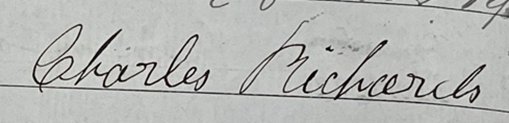
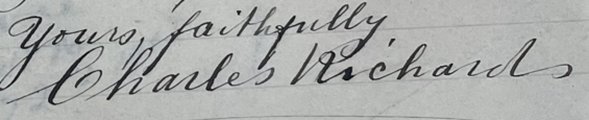
In his absence, the farm was managed by his older children. When a routine drain inspection in early 1913 found a boundary drain not clean - a maintenance obligation written into the title of the land itself - a forfeiture notice was issued on 12 April 1913 and advertised in The Australasian on 3 May as part of a scheduled Land Board sitting covering many Koo-Wee-Rup selectors.35 The response came promptly: a letter dated 17 April 1913, signed "Charles Richards" and posted from Garfield Post Office, told the Department that his share of the drain had been cleaned before the notice arrived, and that work had begun as soon as the initial cleaning notice was received in March. Palaeographic comparison (Figure 2) with Charles senior's authenticated signatures on the mortgage declarations suggests this letter was written by his son, Charles Frederick Richards, then about nineteen, who was managing the farm in his father's absence. On 7 May 1913, the district steward reported the drain now clean. The matter was closed.

On Wednesday, 22 October 1913, Charles was working at the 970-foot level of the South mine, Broken Hill, when a piece of timber thrown down a winze - a vertical internal shaft - struck him on the left side of the head, fracturing his skull. He was carried to the ladderway by workmates and admitted to the Broken Hill Hospital at about four o'clock that afternoon. He never regained speech. He died at 9.15 on the night of Sunday, 2 November 1913, twelve days after the accident.36
A coroner's inquest was held before Thomas Hall, the city coroner, with a jury of six local men - a draper, a stationer, a tailor, and three miners. Witnesses described what had happened: Charles and his workmate William Richard Long had been shovelling dirt at the 970-foot level while timbermen above threw timber down the winze from the 800-foot level. Between loads, the two men sat back on a piece of timber about twenty feet from the shaft opening, believing themselves clear of danger. A piece of falling timber struck another piece and was propelled sideways. No one saw it coming. The jury returned a verdict of accidental death.
Among those who gave evidence was his son, Charles Frederick Richards - about twenty years old - who identified the deceased, gave his age as forty-eight, confirmed he was born in England and had been in Australia for about thirty years, and told the jury there were seven children alive, the eldest twenty-one and the youngest ten. Whether young Charles had followed his father to Broken Hill to work, or had been summoned after the accident, the record does not say. He was there. He spoke for his father before the coroner, and then carried the news home.
Charles Richards died on 2 November 1913. He was buried at Broken Hill on 5 November 1913.37 He left no will. His estate - the freehold farm at Iona, the livestock, the old tools, £2 and ten shillings in cash - amounted to £1,284 and two shillings in total. Probate was granted on 8 May 1914, with Lily - now living in East Richmond and working as a factory hand - named administratrix.38 He had spent nearly thirty years in Australia - longer than he had ever lived in England - and he died far from where he was born, under a name that was not his own.
What Was Left Behind
The burden that fell on Charles' children after his death was formidable. The Trustees Executors mortgage - instrument 279340, registered 25 January 1910 - remained outstanding against the property. In January 1915, eight months after probate was granted, Lily took out a further mortgage to a George Godfrey,39 almost certainly to help service the existing debt or fund the family's survival. That same year, in July 1915, her brother Charles Frederick enlisted in the Australian Imperial Force, listing Lily as his next of kin and noting that he had two younger brothers aged twelve and thirteen dependent upon him.40
How the family maintained the mortgage repayments through the war years is not known. The older children were in Melbourne working in factories. The two youngest boys were according to family stories thought to have been put in an orphanage but no Ward of the State records for the boys can be found.41 It was not until 19 May 1920 - six years after Charles' death, with the war over and Lily now married as Mary Lily Dixon - that both mortgages were simultaneously discharged and the land sold to John Joseph Bensted of Tervale, a local farmer. The sixty acres that Charles Richards had taken up as raw swampland in 1894 and farmed for nearly twenty years passed out of the family that had built it. The Bensted family would hold it for nearly seventy years.
A Hidden Past: The Documents That Were Burned
A story has been passed down through the family, told by a grandmother to her grandchildren, and later confirmed in separate accounts by her children to other family members - of a visit, at the farm at Iona, by strangers described as well-dressed. These visitors came to the house, and after they left documents were burned. The identity of the visitors, the precise date of the incident, and the nature of what was destroyed are not known from the family accounts as they have survived.42
The story of the well-dressed strangers and the burned documents sits alongside all the other silences in Charles Richards' life - the name he never explained, the birthplace he could never quite name consistently, the Sussex he left and never returned to - as a reminder that some of what a person carries, they carry alone.
Rediscovering the Truth: DNA and the Sussex Connection
For generations, nothing was known of Charles Richards' true origins. His own children knew only the story he had given them - the parents' names, the vague English birthplaces, the silence about the years before 1891. It was not until DNA testing became available that the picture finally came into focus.
Analysis using BanyanDNA software, drawing on the shared DNA matches of tested descendants, has demonstrated that Charles Richards was in all likelihood born Richard Cobb, the biological son of Thomas Cobb and Harriett Voller of Linchmere, Sussex. More than twenty tested descendants triangulate to the Cobb family line, and nine more to the Voller line. The DNA model was validated using Bayesian analysis with standard deviation methodology, producing results within acceptable parameters across all tested matches.43 Alternative hypotheses, including sole descent through the family of Thomas Richards and Louisa Cole in Staffordshire, produced only two triangulating matches, one of which traced to a connection through Emily's father, James Bomford, rather than Charles' paternal line.
The 1881, 1891, and 1905 signatures form a coherent sequence showing the same hand developing from youth to maturity. The 1881 and 1891 signatures form part of the evidence establishing Richard Cobb and Charles Richards as the same individual.
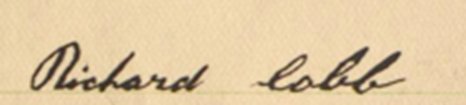
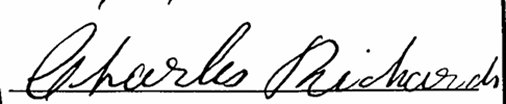
Corroborating evidence comes from Charles' younger brother Herbert, who followed a strikingly similar path. Herbert Cobb (born 26 May 1863, Linchmere) joined the Royal Navy in 1882 and later deserted his ship, HMS Partridge, at Trujillo, Honduras in July 1889.44 He subsequently appears in records as Arthur Taylor, retaining the same birth date and Sussex birthplace. Two brothers, two new names, two lives built in the shadow of the same Sussex childhood. Their sister Louisa married and moved to Somerset; another sister Harriett went with her and did not marry; William remained in Linchmere and married, though had no children. The family scattered - but the Cobb brothers scattered furthest, and under assumed names.
The connection to the Cobb family is confirmed by another detail Charles gave on his own marriage certificate: the name Louisa Hardy for his mother. Louisa Hardy was not an invention - she was the step-sister to Harriett Voller, Richard Cobb's biological mother. A man inventing a fictional past from whole cloth would hardly have reached for so precise and obscure a family connection. It is the kind of detail that only makes sense if Charles Richards truly was Richard Cobb - a boy born in Sussex, son of Thomas and Harriett, who went to sea at sixteen and never came home by his original name.
A Note on Sources, Methods, and Family Tradition
This narrative draws on civil birth, marriage, and death registrations; the 1851, 1871, and 1881 England censuses; Merchant Navy and Royal Navy service records; Victorian deserters' registers; shipping reports in Lloyd's List and other period newspapers; the Crown Land file VPRS 1606/110 held at the Public Record Office of Victoria (examined 26 Mar 2026); Crown Grant documentation; title memorials; probate records; electoral rolls; coroner's inquest records; the newspaper accounts of Emily's death and Charles' inquest; and DNA analysis conducted using BanyanDNA software.
Family oral history has been incorporated in the section on the burned documents. In accordance with genealogical best practice, this material is clearly identified as oral tradition, attributed to named informants across three generations, and distinguished from documentary evidence.
Ron Jones conducted extensive prior research into Charles Richards' English origins, documenting the failure to find any Thomas Richards and Louisa Hardy family with a son named Charles in Staffordshire records, and noting that 'Minhurst' as a birthplace could not be located - a finding consistent with the subsequent DNA-based identification of Charles Richards as Richard Cobb of Midhurst registration district, Sussex.
Citations follow Elizabeth Shown Mills, Evidence Explained: Citing History Sources from Artifacts to Cyberspace, 3rd ed. (Baltimore: Genealogical Publishing, 2015).
Notes
- 1851 census of England, Sussex, Midhurst, Linchmere Parish, Enumeration District 5, page 6, entry for Richard Cobb, age 71, labourer in woods, with Thomas Cobb listed as labourer's son in woods; "1851 England Census," database with images, Ancestry (https://www.ancestry.com : accessed 30 Mar 2026); citing The National Archives of the UK, piece 1654, folio 310, page 6, Household Schedule Number 23. Note: "labourer's son in woods" is a relationship and occupational descriptor; Thomas's own role in the woodland trade is inferred from context rather than stated explicitly.
- DNA analysis tracing the Cobb and Voller family lines in the Linchmere area to the early-to-mid eighteenth century: AncestryDNA match list for Sharon Richards managed by the researcher, 3 Dec 2025, Ancestry (www.ancestry.com : accessed 11 March 2026). BanyanDNA JSON file for project "Cobb Vollar Taylor Richards Validation," generated 21 Mar 2026, held by Sharon Richards. Contains tree structure, match data, mean cM, expected cM ranges, standard deviation variances. BanyanDNA, "Cobb Vollar Taylor Richards Validation," (https://app.banyandna.com/project/d46a1bce-6ed5-4572-b925-ca73b343592a : 30 Mar 2026), probabilities for tree placement for descendants of Charles Richards and Arthur Taylor (MRCA: Luke Cobb (1735-1813) and Ann Stenning (1747-1790)).
- On the decline of the High Wealden woodland trades in the nineteenth century: Fuller, Robert & Warren, Martin (1993), Coppiced Woodlands: Their Management for Wildlife. On the displacement of oak bark tanning by chrome tanning processes: Maverick Leather, The History and Process of Chrome Tanning Leather, https://maverickleathercompany.com : 30 Mar 2026; chrome tanning was introduced commercially in the 1880s and had substantially displaced oak bark by the 1890s. On the decline of charcoal iron production in Sussex: Jeremy Hodgkinson, Wealden Iron Research Group, https://www.wealdeniron.org.uk/history : 30 Mar 2026.
- Register of Apprentices, "UK, Apprentices Indentured in Merchant Navy, 1824-1910," entry for Richard Cobb, bound 11 December 1877, Littlehampton, Sussex; database with images, Ancestry (https://www.ancestry.com : accessed 30 Mar 2026); Class BT 150, Piece 42: Surnames C-F (1875-1879), image 97 of 415; citing The National Archives of the UK, Kew.
- Royal Navy Registers of Seamen's Services, entry for Herbert Cobb, service number 121023, 12 Sep 1882; database with images, Ancestry (https://www.ancestry.com : accessed 30 Mar 2026); Class: ADM 188; Piece: 157.
- England, General Register Office, PDF copy of an entry of birth, for Richard Cobb, born 17 Apr 1861 and registered 7 May 1861; Registration District of Midhurst, Sussex; digital image, General Register Office (https://www.gro.gov.uk : accessed 30 Mar 2026).
- 1871 census of England, Sussex, Midhurst, Linchmere Parish, Enumeration District 4, page 12, entry for Thomas Cobb 58, Harriett Cobb 44, William Cobb 15, Louisa Cobb 13, Richard Cobb 9, Herbert Cobb 7, Harriett Cobb 5 and Leticia Cobb 1; "1871 England Census," Ancestry (https://www.ancestry.com : accessed 30 Mar 2026); The National Archives of the UK, piece 1121, folio 42, page 12, Household Schedule Number 57.
- Thomas Cobb (born approximately 1817, Linchmere), burial record, St Peter and St Paul Churchyard, Rustington, 23 November 1898; "Thomas Cobb," Find A Grave, memorial no. 260181777 (https://www.findagrave.com/memorial/260181777/thomas-cobb : accessed 29 Mar 2026). England, General Register Office, death certificate for Thomas Cobb, died 19 Nov 1898, Registration District of East Preston; informant: William Cobb, son, present at death, Rustington.
- Crew list, Falcon (official no. 43512), voyage commencing Littlehampton, 15 December 1877; West Sussex Record Office, document SR/207/35. Richard Cobb listed as apprentice seaman under Master Richard J. Burt.
- Cape Hatteras, on the Outer Banks of North Carolina, USA, is situated where the warm northbound Gulf Stream and the cold southbound Labrador Current converge at Diamond Shoals, creating unpredictable seas and shifting sandbars. The Falcon's crew lists document voyages between Wilmington, North Carolina and European ports. Crew lists, Falcon (official no. 43512), voyages commencing Cardiff April 1879 and London January 1880; West Sussex Record Office, SR/207 documents 38-40. Cape Hatteras National Seashore North Carolina, Lost to the Perils of the Sea, https://www.nps.gov/caha/learn/historyculture/shipwrecks.htm : accessed 30 Mar 2026.
- The National Archives, Kew (TNA), "1881 England Census," entry for Richard Cobb, age 20, able-bodied seaman, aboard the Falcon; Class RG11, Piece 1120, Folio 100, Page 8, GSU roll 1341274; database with images, Ancestry (https://www.ancestry.com).
- Merchant ship Bridesmaid (official no. 71482), Swansea registry, crew agreement and account of crew, voyage ending 1881; Swansea Archives (https://www.swansea.gov.uk/archivecollections).
- "Kentish Tar," Lloyd's List, 20 May 1881, p. 7, reporting vessel passing Dover from London bound Cardiff; digital image, FindMyPast (https://findmypast.com : accessed 11 Feb 2026). Arrival at Table Bay: "Kentish Tar," Shipping and Mercantile Gazette, 19 Sep 1881, p. 3; FindMyPast (accessed 11 Feb 2026).
- "Morning Star," Shipping and Mercantile Gazette, 15 Feb 1882, p. 3; FindMyPast (accessed 10 Feb 2026). The Morning Star, under Captain Innes, sailed for Cape Town from Mauritius 28 Dec 1881.
- "Morning Star," Shipping and Mercantile Gazette, 21 Jul 1882, p. 4; FindMyPast (accessed 11 Feb 2026): "MORNING STAR schooner, Innes, which arrived here yesterday from Mauritius, reports having experienced a severe gale May 10, in lat. 39 S, long. 114 E, during which the two boats, the galley, and the topgallant bulwarks were stove, and everything movable on deck was swept overboard. (Melbourne, May 27.)"
- "Morning Star," Shipping and Mercantile Gazette, 11 Nov 1882, p. 3; FindMyPast (accessed 11 Feb 2026).
- "Morning Star," Shipping and Mercantile Gazette, 14 Feb 1883, p. 4; FindMyPast (accessed 11 Feb 2026). The Argus, 16 Dec 1882, p. 8; Trove (https://trove.nla.gov.au/newspaper/article/11562539 : accessed 3 Feb 2026).
- Public Record Office of Victoria (PROV), "Victoria, Australia, Deserter, Discharged, and Prisoner Crew Lists, 1852-1925"; entry for Richard Cobb, deserted Morning Star, reported 18 January 1883, previously on Kentish Tar; Ancestry (https://www.ancestry.com : accessed 30 Mar 2026); Series 2144, Volume 3, image 102 of 268.
- Births, Deaths and Marriages Victoria, marriage register, Registration Number 5451/1891, Charles Richards and Emily Macauley, married 30 July 1891, St Mary's Roman Catholic Church, West Melbourne; Charles listed born England ca. 1865, parents Thomas Richards (miner) and Louisa Hardy.
- On Catholic requirements for marriage involving a non-Catholic party in the late nineteenth century: the Church required either full conversion or baptism in another faith followed by a diocesan bishop's dispensation, with conditions including a promise that children would be raised Catholic and instruction of the non-Catholic party in the Catholic faith. Wikipedia, "Marriage in the Catholic Church" (https://en.wikipedia.org/wiki/Marriage_in_the_Catholic_Church : accessed 30 Mar 2026). St Mary's Star of the Sea, West Melbourne has been contacted by email requesting access to historical parish records; response awaited at time of writing.
- PROV, Crown Land file VPRS 1606/110, Application for Swamp Lands Permissive Occupancy under Part I, Division 6, Land Act 1890, signed by President and Member of the Board of Land and Works, permitting Charles Richards to occupy allotment 7, Section O, Parish of Koo-wee-rup East, twenty acres, for three years from 1 July 1894 at one pound per half-year; seal affixed 3 July 1894. Examined at PROV, 26 Mar 2026.
- Carlo Catani, Koo Wee Rup Swamp Drainage history, https://carlocatani.blogspot.com/2018/10/koo-wee-rup-swamp.html : accessed 30 Mar 2026.
- PROV, Crown Land file VPRS 1606/110: letter, Charles Richards, Bunyip, to Department of Lands and Survey, 7 Dec 1898; Richards applies for Block 57, Section O. Examined at PROV, 26 Mar 2026.
- PROV, Crown Land file VPRS 1606/110: Conditional Purchase Lease, Board of Land and Works to C. Richards, indenture dated 9 April 1903, seal affixed 22 May 1903; allotments 7, 57 and 58, Section O, Parish of Kooweerup East, 60 acres; purchase money £184; fifty-eight half-yearly instalments; signed by Charles Richards, witnessed by Janet Bell, Post Mistress, Bunyip South. Examined at PROV, 26 Mar 2026.
- PROV, Crown Land file VPRS 1606/110: Power of Attorney, Charles Richards to Arthur James Mollison, produced 8 November 1904, No. 29845. Examined at PROV, 26 Mar 2026.
- PROV, Crown Land file VPRS 1606/110, mortgage applications: (1) Charles Richards to Edith Christy Smith, Toorak, £150 at 6%, approved 17 May 1905, improvements £500, fencing 115 chains, purpose "To buy cattle & clear his land." (2) Charles Richards to Emma Shaw, £50, 6%, approved 1 November 1905, purpose "To buy a horse and improve property." (3) Charles Richards to Harry Felce Richardson, £150 at 6%, declared 7 July 1906 [thirteen days after Emily's death], purpose "to further improve the property by fencing … building new sheds," approved 6 August 1906. (4) Charles Richards to Francis Grey Smith, Solicitor, £100 at 6%, declared 13 July 1907, improvements £520, fencing 134 chains, approved 1 August 1907. (5) Charles Richards to Edith Marian Pendred, widow, Elsternwick, £100 at 6%, declared 6 June 1908, improvements £521.11.0, fencing 148 chains, purpose "to buy further land to graze young cattle in winter," approved 3 July 1908. All c/o G.A.J. Mollison, Solicitor, 281 Collins Street, Melbourne. All examined at PROV, 26 Mar 2026.
- PROV, Crown Land file VPRS 1606/110: Application for Crown Grant, Charles Richards, received 11 October 1909; declaration sworn at Melbourne 4 October 1909 before John J. Finnucan, Commissioner of the Supreme Court of Victoria; continuous residence declared "the whole time"; improvements declared £849; independent valuation by T.C. Chippindall, Crown Lands Bailiff, 18 October 1909, total £413.10.0; grant recommended 30 November 1909. Examined at PROV, 26 Mar 2026.
- The Trustees Executors and Agency Company (TEA) was established in Victoria in 1878 and was the first trustee company formed in Australia; its formation required a special Act of Parliament (https://classic.austlii.edu.au/au/legis/vic/hist_act/nteaacoala679/). Wikipedia, "Trustees Executors and Agency Company" (https://en.wikipedia.org/wiki/Trustees_Executors_and_Agency_Company : accessed 30 Mar 2026).
- Crown Grant, Edward VII to Charles Richards, allotments 7, 57 and 58, Section O, Parish of Koo-wee-rup East, 60 acres, dated 11 January 1910; witnessed by Sir Thomas David Gibson Carmichael, Governor of Victoria; Register Book Vol. 3379, Fol. 615628. Copy obtained from Land Use Victoria, 27 Mar 2026. Discharge of five private mortgages on 12 January 1910 confirmed by memorial entries on the original title: Edith Christie Smith (instrument 235065), Emma Shaw (instrument 238605), Harry Felix Richardson (instrument 244868), Francis Grey Smith (instrument 253787), Edith Marian Pendred (instrument 263428).
- Births, Deaths and Marriages Victoria, birth register entries: Mary Lilian Richards, no. 23342/1892; Charles Frederick Richards, no. 31709/1893; John Richards, no. 1514/1895; Emily Alice Richards, no. 9188/1897; William Herbert Richards, no. 9192/1900; Edward Norman Richards, no. 1304/1902; Myrtle Richards (1898); Laurence Richards (1903); Stanley Richards (1906). PDF copies held by Sharon Richards.
- Births, Deaths and Marriages Victoria, death register entry: Mary Mooney (1895). PDF copy held by Sharon Richards.
- PROV, VPRS 4527/P0000, 5867-8913, Boys neglected, Book 8, 20 Jan 1872-25 Nov 1878; 6124- William Macauley and 6125- John Macauley; digital image, image 68 of 736 (https://prov.vic.gov.au/archive/A0C05808-F4C7-11E9-AE98-17B2886C03DB?image=68 : 31 Mar 2026).
- "Iona," South Bourke and Mornington Journal, 27 June 1906, p. 2; Trove, National Library of Australia (https://trove.nla.gov.au/newspaper/article/66144875 : accessed 31 Mar 2026). Also: Births, Deaths and Marriages Victoria, death register, Emily Macauley Richards, died 24 June 1906, Melbourne; burial Bunyip, 26 June 1906.
- Heather Arnold, "Koo Wee Rup Swamp Drainage History," Carlo Catani (blog), 13 October 2018 (https://carlocatani.blogspot.com/2018/10/koo-wee-rup-swamp.html : accessed 31 Mar 2026), drawing on Lewis Ronald East, "Swamp Reclamation in Victoria," Journal of the Institute of Engineers, Australia, March 1935, and David Roberts, From Swampland to Farmland: A History of the Koo Wee Rup Flood Protection District (Rural Water Commission of Victoria, 1985).
- On wages at Broken Hill: Bill O'Neil, "The BHP Lockout of 1909," Journal of Australasian Mining History, Vol. 10, October 2012, p. 129 (https://www.mininghistory.asn.au/wp-content/uploads/10.-ONeillCOMPLETED9Vol.10.compressed.pdf : 31 Mar 2026).
- "Hearings against Forfeiture," The Australasian, 3 May 1913, p. 5; Trove (https://trove.nla.gov.au : accessed 20 Mar 2026). PROV, Crown Land file VPRS 1606/110: drain notice issued 12 April 1913; letter signed "Charles Richards," Garfield P.O., 17 April 1913. Palaeographic analysis draws on five reference signatures spanning 1881-1915: (1) Richard Cobb, Bridesmaid crew list, 1881; (2) Charles Richards, marriage certificate, 30 July 1891; (3) Charles Richards, letter 1904; (4) drain letter signature, 1913; (5) Charles Frederick Richards, AIF enlistment papers, 14 July 1915, National Archives of Australia. The 1913 and 1915 signatures match closely; both differ materially from the 1891 and 1904 signatures. Internal file note (red ink): "L.B. Bunyip, 7.5.13 - Steward reports drain now clean." Examined at PROV, 26 Mar 2026.
- State Records Authority of New South Wales, "New South Wales, Registers of Coroners' Inquests, 1821-1937," entry for Charles Richards, no. 3 (1913 register), coroner Thomas Hall, verdict: accidental death; Ancestry (https://www.ancestry.com : accessed 20 Mar 2026). Also: "Death of Mr Charl Richards. Proceedings at the Coroner's Inquest," Barrier Miner (Broken Hill, NSW), 4 November 1913, p. 3; Trove (https://trove.nla.gov.au/newspaper/article/45234977 : accessed 30 Mar 2026).
- Find A Grave records 26 October 1913 as the death date, which is incorrect; this is the date Charles was injured. The correct death date of 2 November 1913 is confirmed by probate records and the title memorial. "Funeral of Mr Charles Richards," Barrier Miner, 5 Nov 1913, p. 6; Trove (https://trove.nla.gov.au/newspaper/article/45205649 : 1 Apr 2026).
- Supreme Court of Victoria, probate records, estate of Charles Richards, inventory sworn 3 March 1914 by Mary Lily Richards; grant of probate 8 May 1914; total estate £1,284:2:0; "Victoria, Australia, Wills and Probate Records, 1841-2009," Ancestry (https://www.ancestry.com). Memorial of Instruments, Vol. 3379, Fol. 615628: Letters of Administration granted 8 May 1914 to Mary Lily Richards of 14 Kingston Street East Richmond, Factory Hand, dated 27 November 1914.
- Memorial of Instruments, Vol. 3379, Fol. 675628: mortgage, Charles Richards to The Trustees Executors and Agency Company Limited, 25 January 1910, instrument 279340, discharged 18 May 1920; mortgage, Mary Lily Richards to George Godfrey, 8 January 1915, instrument 324694, discharged 18 May 1920; transfer to John Joseph Bensted, Farmer, registered 18 May 1920. Copy obtained from Land Use Victoria, 26 Mar 2026.
- First Australian Imperial Force Personnel Dossiers, service record for Charles Frederick Richards, enlisted 14 July 1915; National Archives of Australia, B2455, service number 3600; Ancestry (https://www.ancestry.com : accessed 31 Mar 2026). Charles Frederick Richards stated he had two brothers aged 12 and 13 dependent upon him.
- Ron Jones, First Families 2001, Emily Macauley; Trove (https://webarchive.nla.gov.au/awa/20050217021521/http://pandora.nla.gov.au/pan/10421/20041220-0000/www.firstfamilies2001.net.au/firstfamilybef4.html : 31 Mar 2026).
- Oral history tradition reported by Emma Daisy Richards (daughter-in-law of Charles and Emily Richards), as related to Sharon Richards (1970s); subsequently confirmed in separate accounts by Rhonda Richards (2026, as relayed to her by Noel Richards) and Helen Hegney (2026, granddaughter of Charles and Emily Richards); privately held recollections, Sharon Richards, Australia.
- Sharon Richards, Validation "Check" for Project "Harriet & Thomas as parents without Cobb siblings," BanyanDNA (https://www.banyandna.com/home), validation generated 30 January 2026; privately held by Sharon Richards, Australia. Also: Sharon Richards, Validation "James Bomford is father of Henrietta" for Project "Bomford & Richards Connect?," validation generated 1 February 2026; privately held by Sharon Richards, Australia.
- General Register Office (England), birth certificate for Herbert Cobb, born 26 May 1863, Registration District of Midhurst, Sussex; GRO (https://www.gro.gov.uk : accessed [date]). Royal Navy service: The National Archives, Kew, "UK, Royal Navy Registers of Seamen's Services, 1848-1939," service record for Herbert Cobb; Class ADM 188, Piece 157, image 23 of 544; Ancestry (https://www.ancestry.com : accessed 31 Mar 2026). Papers record birthplace as Linchmere, Sussex; enlisted 12 September 1882; deserted HMS Partridge at Trujillo, Honduras, 1 July 1889.