The Sussex Woodlands
Richard Cobb was born on 17 April 1861 in Linchmere, a small parish in the western High Weald of Sussex, deep in woodland country. The Cobb and Voller families had lived in and around Linchmere for generations, the men predominantly agricultural labourers whose lives were shaped by the Wealden countryside and its woodland trades.
Richard's mother, Harriett Voller, died around 1872 when he was still a boy. By the mid-1870s, with the woodland trades contracting and little future for a labourer's son in Linchmere, Richard turned to the sea. In 1877, at the age of sixteen, he began a maritime apprenticeship that would take him far from the Sussex woods.
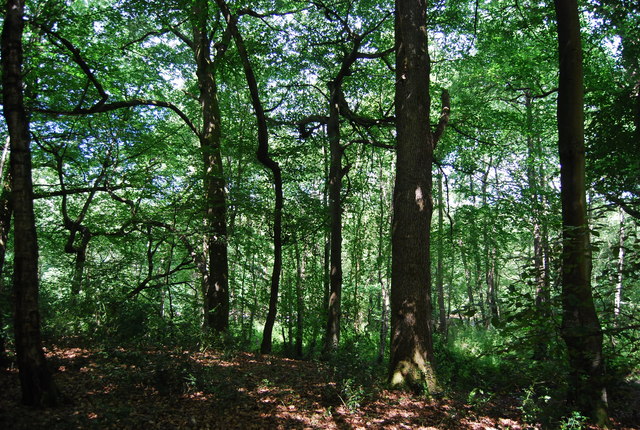
Gillham’s Wood, near Linchmere, West Sussex · The ancient oak woodland adjoining Linchmere parish, acquired by the Woodland Trust in 1992. The Cobb and Voller families lived and worked in woodland country of this character for generations. · © N Chadwick, licensed under CC BY-SA 2.0 via Geograph Britain and Ireland.
A Life at Sea
Richard's maritime career began in 1877 with an apprenticeship aboard the Falcon, a three-masted barkentine of 318 tonnes built in 1864 - square-rigged on the foremast with fore-and-aft rigged main and mizzen masts, of the distinctive type shown opposite. Over the following years he navigated routes between the West Indies, the Americas, and Europe.
On 12 April 1881 he signed onto the Bridesmaid for a single voyage from Honfleur, Calvados, France, arriving at Swansea, Glamorgan, Wales on 22 April 1881. Later that year he served aboard the Kentish Tar, sailing to Cape Town, South Africa. His final voyage under his true name came aboard the Morning Star, a three-masted schooner that survived severe Indian Ocean gales and loss of rigging before arriving in Melbourne in December 1882.
On 18 January 1883, Richard Cobb deserted the Morning Star in Melbourne. Within weeks he had abandoned his name and his past, reinventing himself as Charles Richards.
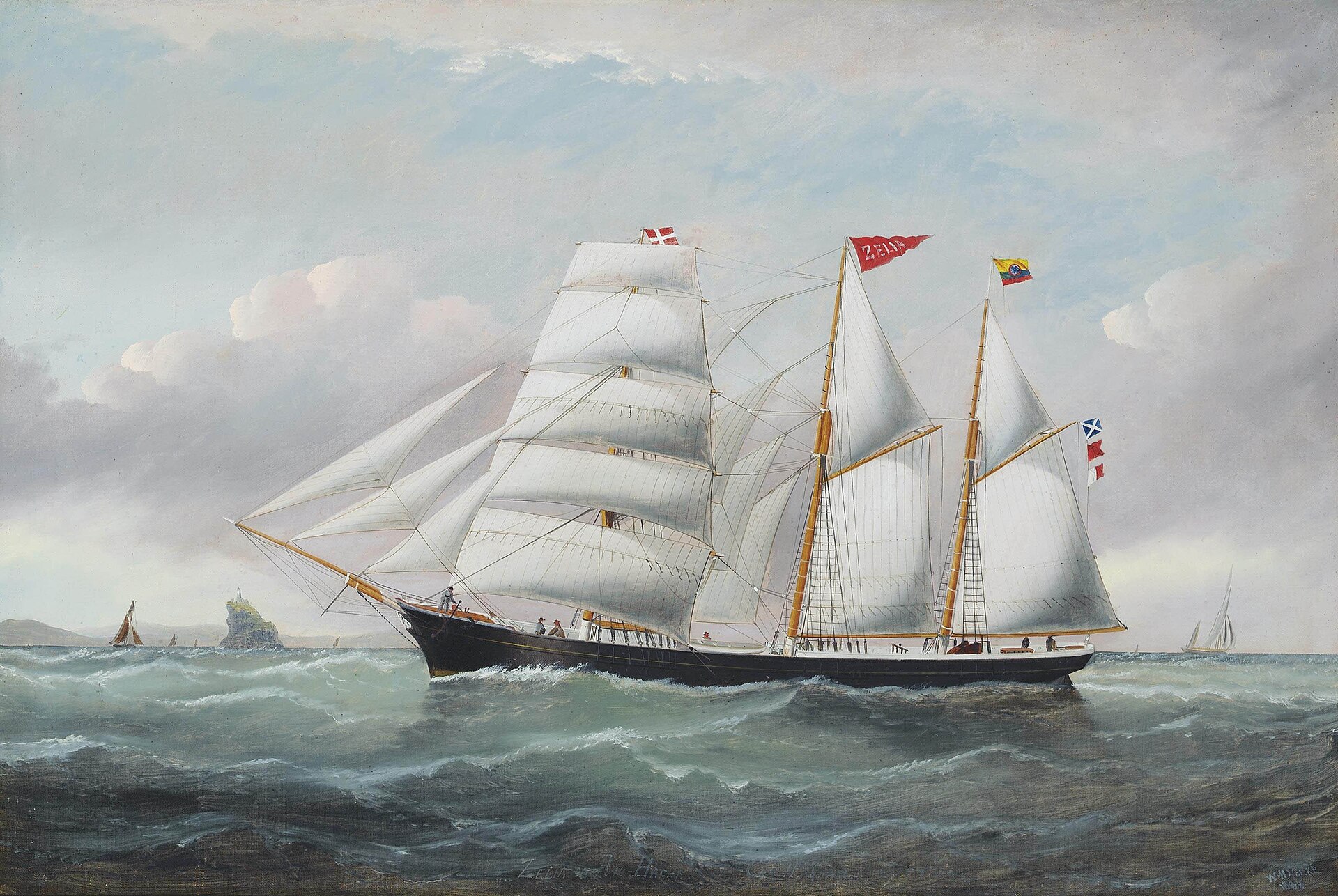
William Howard Yorke (1847-1921) - The Colombian barquentine ‘Zelia’ · Public domain, Wikimedia Commons. The three-masted barkentine rig - square-rigged foremast with fore-and-aft rigged main and mizzen masts - identical to that of the Falcon on which Richard Cobb served his maritime apprenticeship.
Richard Cobb served on four vessels between 1877 and 1883 - the Falcon, Bridesmaid, Kentish Tar, and Morning Star - navigating routes across the Atlantic, Indian Ocean, and into Port Phillip Bay.
The Voyages of Richard Cobb →Marriage to Emily Macauley
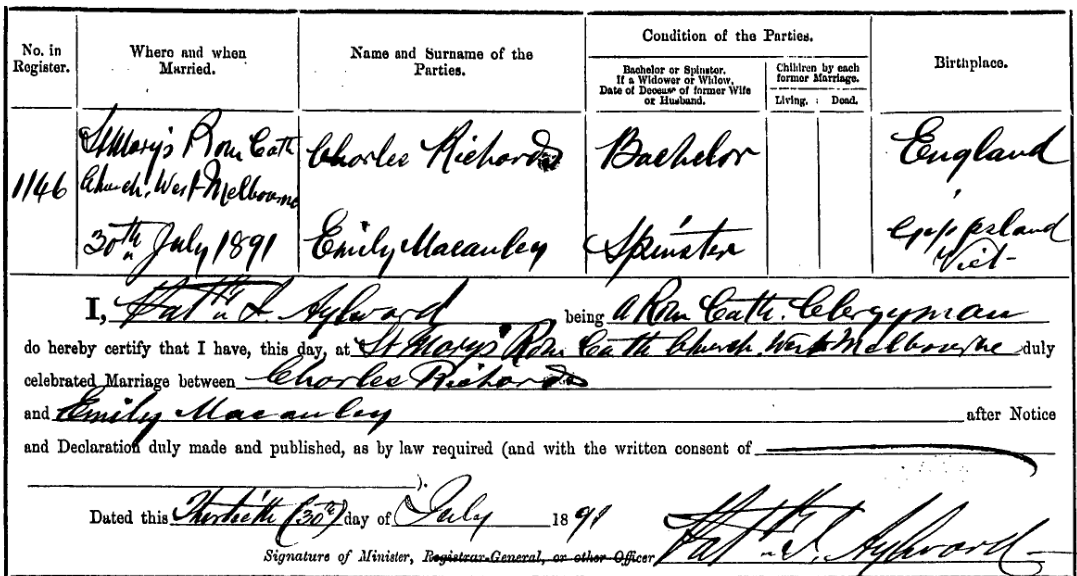
Marriage register, entry 1146 · St Mary’s Roman Catholic Church, West Melbourne · 30 July 1891 · Charles Richards, Bachelor, born England; Emily Macauley, Spinster, born Gippsland, Vic · Births, Deaths and Marriages Victoria
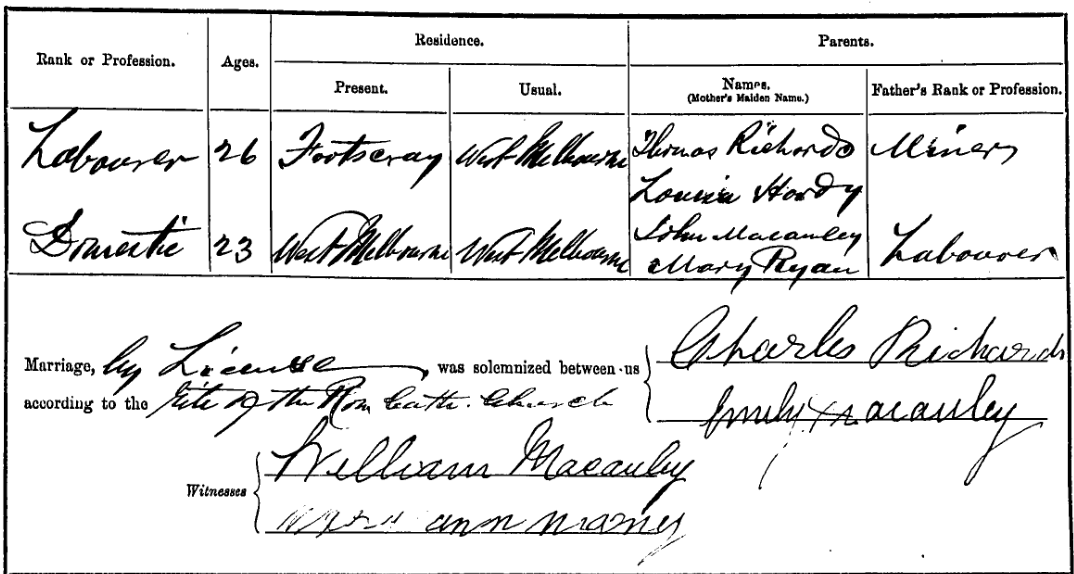
Marriage certificate detail · Signatures of Charles Richards and Emily Macauley, with witnesses William Macauley and Mary Ann Mooney · St Mary’s Roman Catholic Church, West Melbourne · 30 July 1891 · Births, Deaths and Marriages Victoria
On 30 July 1891, Charles Richards married Emily Macauley at West Melbourne. Emily had been registered as the daughter of John Macauley and Mary Ryan, and was born on 20 August 1863 at Tarraville in Gippsland.
The marriage was celebrated in the Catholic faith. Emily's mother, Mary Ryan, had come from Cloyne in County Cork, Ireland, to Gippsland around 1851 - one of the early Irish Catholic settlers in the district. Her family's faith shaped the household in which Emily was raised, and it was into that faith that Charles Richards, formerly Richard Cobb of a Sussex Protestant family, now entered.
Charles and Emily would go on to have nine children, eight of whom survived infancy.
Reclaiming the Koo-wee-rup Swamp
In 1894, Charles Richards claimed the first 20 acres of what would become a 60-acre crown lease at Bunyip South in the Koo-wee-rup Swamp - a vast, flat, black-soiled wetland south-east of Melbourne that was being opened up for settlement through an ambitious government drainage scheme.
The work was brutal. Contractors and selectors alike waded through the flooded, stump-riddled swamp, hand-digging the long straight drainage channels that would slowly drain the waterlogged land and make it fit for farming.
Charles built his allotment incrementally over sixteen years, expanding from the original 20 acres to a 60-acre crown grant confirmed in 1910. The farm at Bunyip South - later known as Iona - became the home in which his eight children grew up.
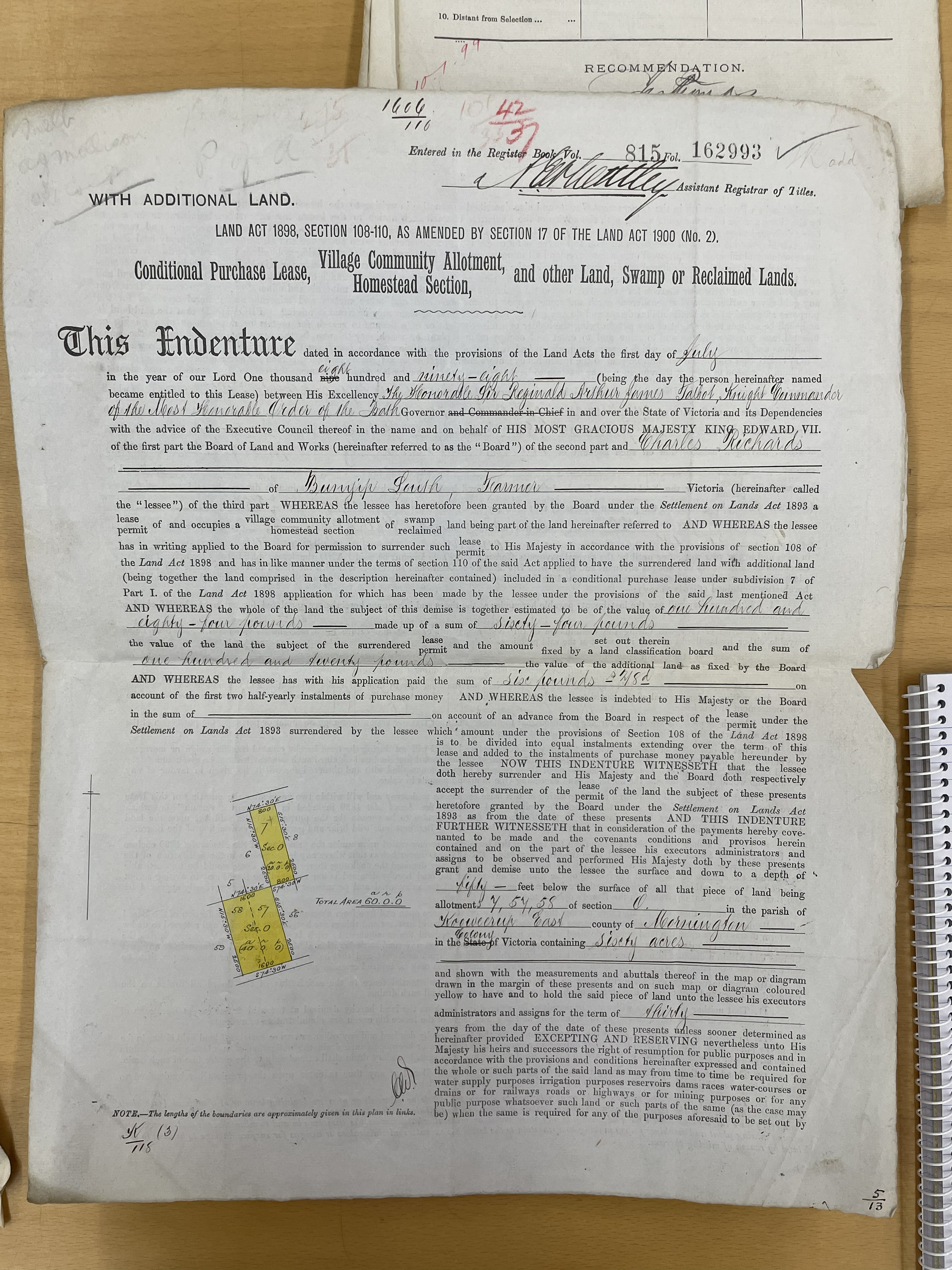
Land indenture, Charles Richards, Bunyip South · Conditional Purchase Lease under the Land Act 1898, showing the 60-acre allotment (sections 54, 55, 56, 57, 58) in the parish of Koooweerup East, county of Mornington, Colony of Victoria · PROV Crown Land file VPRS 1606/110
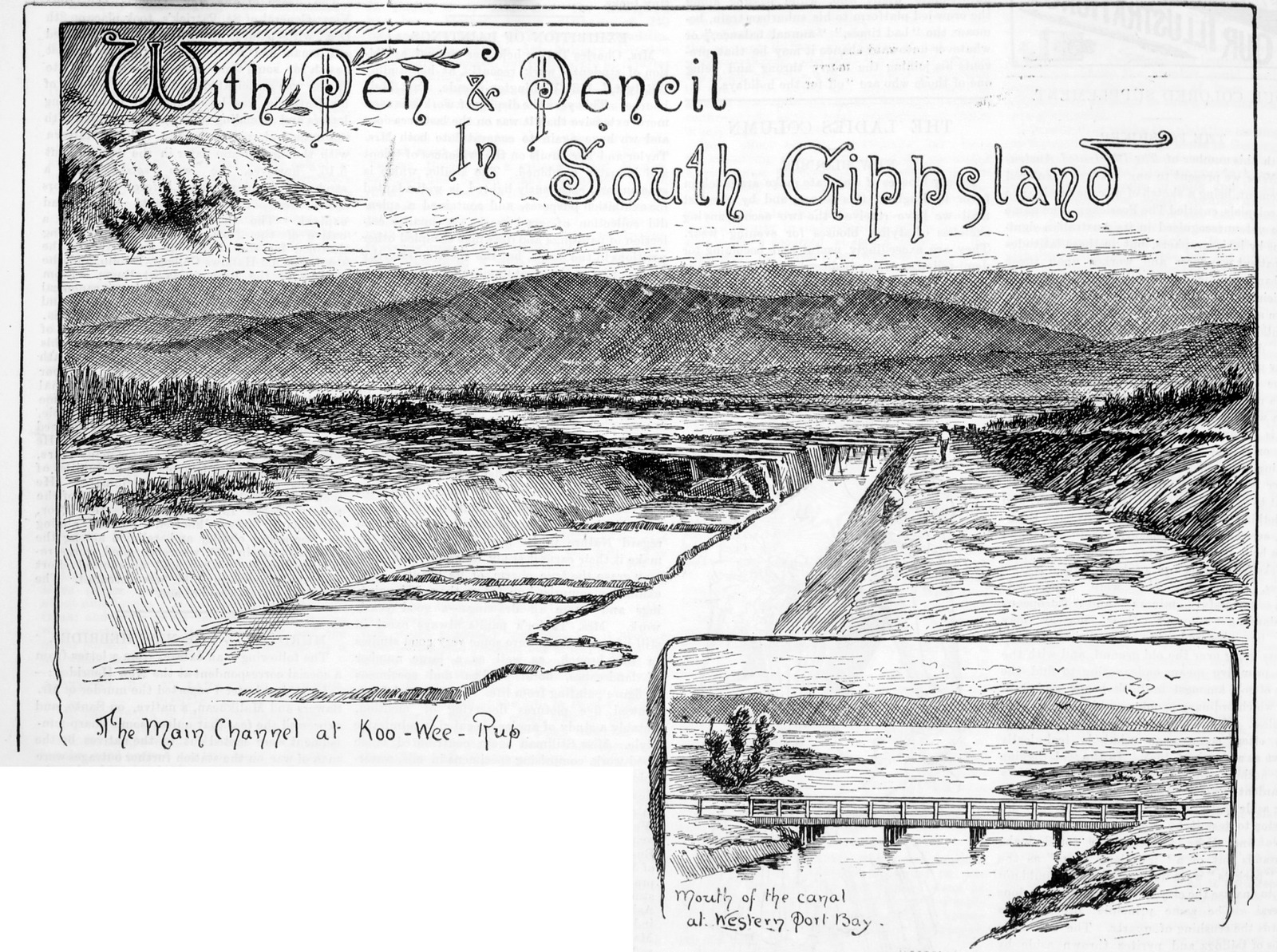
“The Main Channel at Koo-Wee-Rup” · With Pen & Pencil in South Gippsland, c.1891 · Pictures Collection, State Library Victoria.
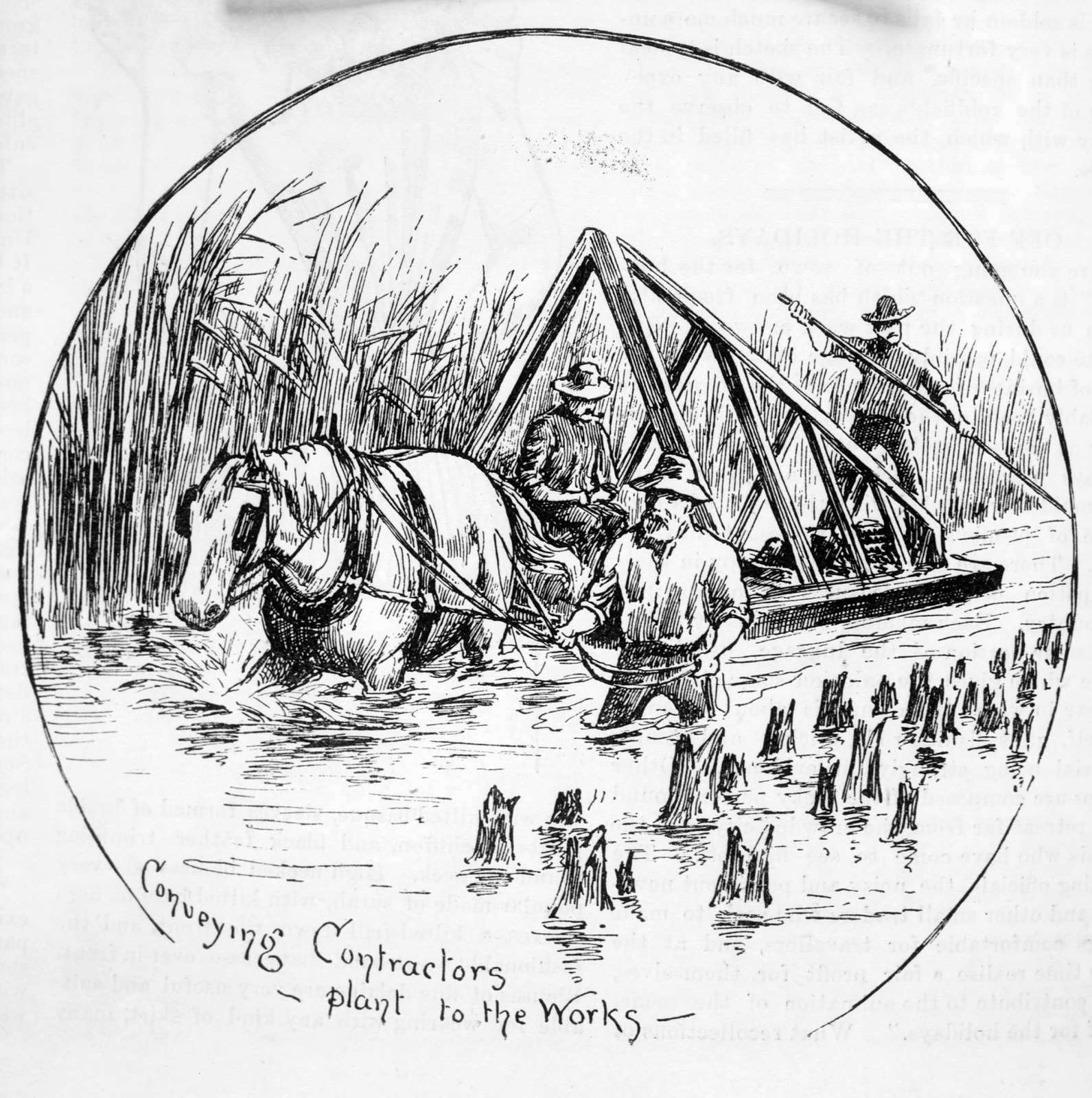
“Conveying Contractors’ Plant to the Works” · With Pen & Pencil in South Gippsland, c.1891 · Pictures Collection, State Library Victoria.
Death at the South Mine, Broken Hill
By 1913, Charles Richards was working underground at the South Mine in Broken Hill. On 2 November 1913, while working at the 970-foot level, a falling timber beam struck him, causing a fatal skull fracture. He was fifty-two years old.
He died under the name Charles Richards - the name he had taken on a Melbourne wharf thirty years before. His true identity as Richard Cobb of Linchmere, Sussex, would remain a secret for decades, until DNA testing made it possible to trace the lineage back across the generations to the woodland families of the High Weald.
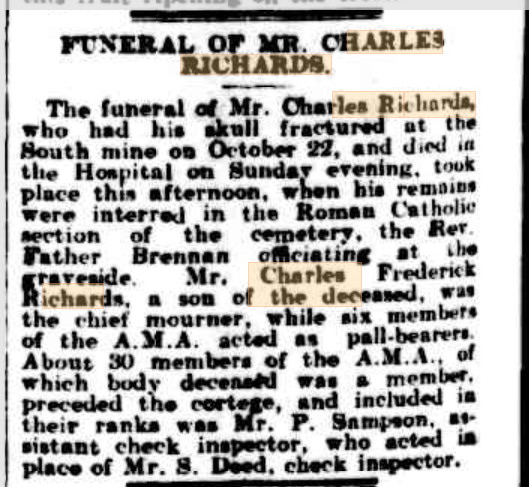
“Funeral of Mr. Charles Richards” · Barrier Miner, 5 November 1913, p. 6 · Courtesy National Library of Australia, Trove · trove.nla.gov.au/newspaper/article/45234977